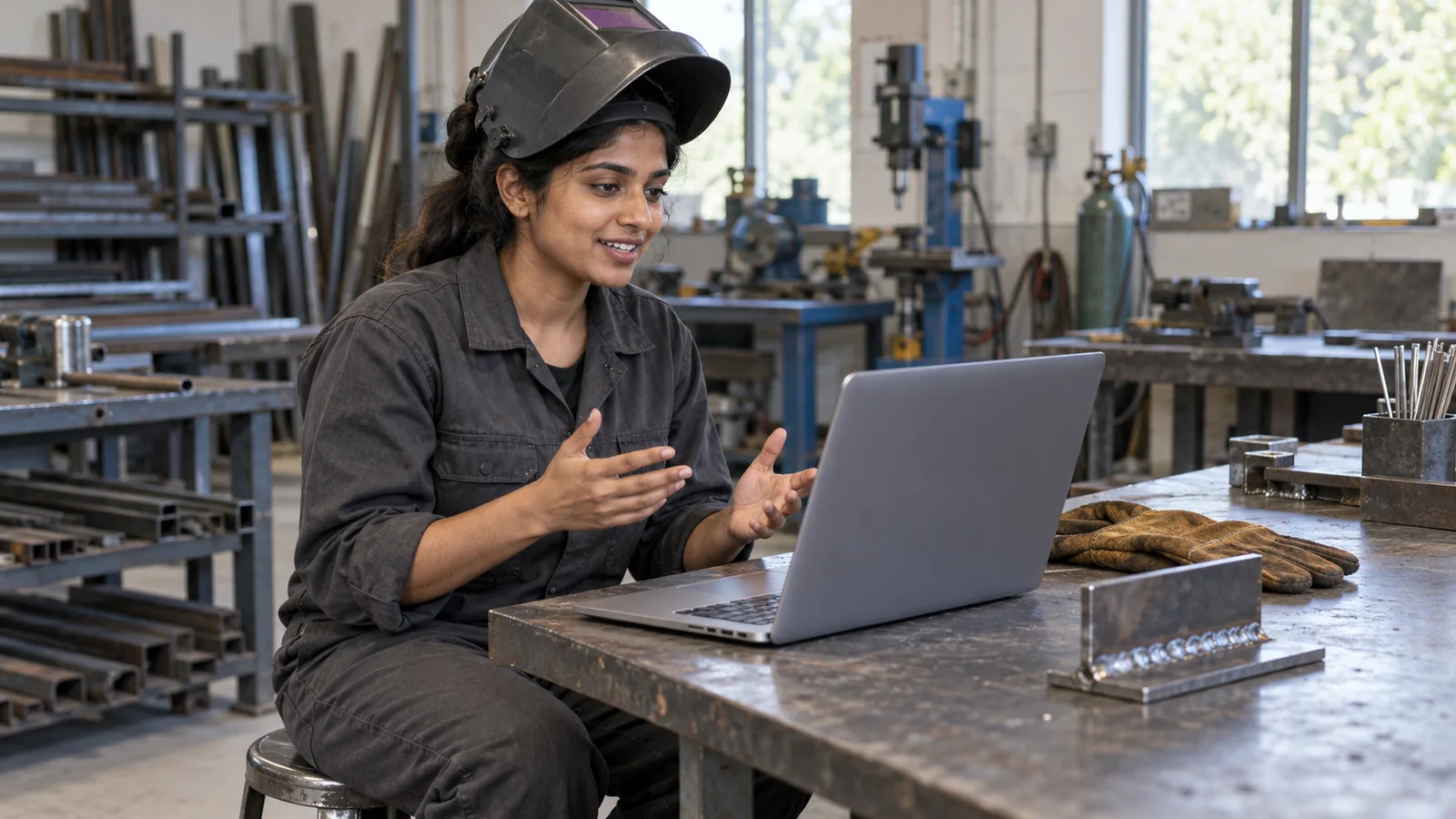
Welder interview questions and answers nearly always cover the same five areas: the welding processes you use, the joints and positions you can weld, how you read a drawing, how you check your own welds, and how you control fume and fire. A strong answer is short. You say what you do, in what order, and why. Below are the questions and sample answers you can change to match your own work.
Who asks the questions, and what they listen for
There are two kinds of welder interview. In a job interview, a supervisor wants to know if you can do the work safely from the first week. In a skills assessment interview, an assessor compares your trade knowledge with a set standard.
For Australia, Trades Recognition Australia (TRA) says the technical assessment is done by a qualified assessor who is also a qualified tradesperson in your occupation. Its Pathway 1 assessment includes a technical interview and may involve a practical demonstration of skills. So the person in front of you has welded for a living.
Employers test as well. New Zealand's government careers site, Tahatū, gives welding as an example of job task tests at interviews. Do not be surprised if you are handed a test piece (a small sample joint) once the talking is over.
Welding process names you will hear in the room
One published assessment guide for fitter-welders lists welding techniques such as MMAW, GMAW, TIG and FCAW among its interview areas. Workshops often use the everyday names. Learn both, plus one sentence about when you choose each process.
| Formal name | Everyday name | A sentence you can say |
|---|---|---|
| MMAW (manual metal arc welding) | Stick, or arc welding | "I pick stick for repair jobs outdoors, because wind cannot blow my shielding away." |
| GMAW (gas metal arc welding) | MIG | "I pick MIG for long runs on steel in the workshop, because the wire feeds without stopping." |
| GTAW (gas tungsten arc welding) | TIG | "I pick TIG for thin stainless steel, where the weld must be neat and exact." |
| FCAW (flux-cored arc welding) | Flux-cored | "I pick flux-cored wire for thick structural steel, because it fills a large joint quickly." |
Welding interview questions about joints and positions
The interviewer listens for the correct word, and for proof that your own hands did the work.
"What types of joints have you welded?"
Name the joint first, then the job. The five basic joints are butt, tee, lap, corner and edge. Most welds on them are fillet welds (a triangle of weld metal in a corner) or butt welds (two plates joined edge to edge).
A simple answer could be: "Most of my work is fillet welds on tee joints and lap joints for steel frames. I also weld butt joints on plate. On thick plate I grind a bevel first, which is a sloped edge. Then the weld can reach the root, the bottom of the joint."
"Which positions can you weld in?"
The four main positions are flat, horizontal, vertical and overhead. Some employers use codes. For butt welds on plate, 1G is flat, 2G is horizontal, 3G is vertical and 4G is overhead. Fillet welds take the same numbers with the letter F.
Be honest. A simple answer could be: "I am confident in flat, horizontal and vertical-up with stick and MIG. I have welded overhead on site, but not often. I want more practice in that position."
"How do you set up a MIG welder for a new job?"
Of all MIG welder interview questions, this one comes up most. Describe your method, not settings you are unsure of.
A simple answer could be: "First I read the procedure sheet, or I ask the supervisor. I check the wire type, the wire size and the gas. Next I set the voltage and the wire feed speed for the thickness of the metal. I run a test weld on scrap of the same thickness. I look at the bead, the line of weld, and adjust the machine before I touch the real job."
Questions about drawings and weld quality
"How do you read a welding symbol on a drawing?"
A simple answer could be: "The arrow points to the joint. The symbol on the reference line shows the type of weld, for example a triangle for a fillet. The figures beside it give the size and the length. A symbol under the line means I weld on the arrow side. A symbol above the line means the other side. If anything is unclear, I ask before I strike an arc."
"What weld defects do you look for, and what causes them?"
Choose three defects you know well. For each one, give the name, a cause and your repair.
The same answer order works outside welding too. Our trade job interview questions and answers guide uses it for tools, safety, faults and teamwork in any trade.
- Porosity (small gas holes in the weld): often caused by dirty or damp metal, or by wind pushing the shielding gas away. "I clean the joint and block the wind."
- Undercut (a groove melted into the plate beside the weld): often caused by too much heat or by travelling too fast. "I turn the setting down and slow my travel."
- Lack of fusion (weld metal sitting on the plate without melting into it): often caused by too little heat or a poor torch angle. "I grind it out and weld it again."
Welding safety interview questions: fume and fire
Australian guidance puts safety controls in a set order. A model code of practice from Safe Work Australia lists them like this: first eliminate the hazard, next substitute something safer, then isolate people from the hazard or use engineering controls, then use administrative controls, and only then use personal protective equipment (PPE) for the risk that remains. The same code calls PPE the lowest order control, because it does nothing to change the hazard itself.
So do not open a safety answer with your helmet. Begin higher up that list. Safe Work Australia also describes four steps for managing risks: identify hazards, assess risks, control risks and review control measures.
"How do you protect yourself from welding fume?"
A simple answer could be: "First I ask if the job can be done another way that makes less fume. I remove paint, oil and coatings near the joint, because they add to the fume. I put the extraction arm close to the arc, and I keep my head out of the fume. I wear the respirator my employer gives me as the last layer."
"What do you do before welding near things that can burn?"
Welding, cutting and grinding are often called hot work. A simple answer could be: "I look around the area and underneath it. I move anything that can burn, or I cover it with a fire blanket. I check that an extinguisher is close. If the site has a hot work permit, I get it signed before I start. When I finish, I stay and watch the area for a while, because a spark can start a fire later."
Our post on workplace safety questions in an overseas trade interview has more questions of this kind, such as what to do when a job is not safe.
How to prepare your answers in five steps
- List your real work. Write down the processes, metals, thicknesses and positions you have welded in the last few years.
- Choose one real job for each process. That job becomes your example.
- Build every answer in four parts. What I do, in what order, why I do it that way, and how I check the result.
- Match your words to the local words. The Picture Quiz for trade words, tools and safety signs is a quick way to test yourself.
- Say each answer out loud and time it.
Common mistakes welders make in interviews
- One-word answers. "Yes, I can MIG" tells the interviewer nothing. Add the metal, the position and one job.
- Saying "we" for everything. The interviewer is choosing you, not your old team. One Canadian government employer tells its own job candidates to use "I" statements and not "we" statements.
- Claiming every process and every position. A test piece may follow, so claim only what you can weld today.
- Guessing when you did not understand. Tahatū's interview tips are to take time to think, and to ask for a question to be explained or repeated.
Practise your welder answers out loud
Words like "porosity" and "undercut" are hard to say under pressure. Say them many times before the day.
The technical trade questions in Skills Practice suit the knowledge questions in this guide. You watch an interviewer ask a question on video, and you answer out loud. You then get a score from 0 to 10, with what you did well, what to add, and a stronger answer. The marking does not take marks off for your accent, small grammar mistakes or simple words.
When single answers feel comfortable, try a full mock interview, or browse the other trades we cover.
Photos of finished welds and copies of your certificates support what you say. Some welders keep them in a candidate profile that shows their skills, so an employer can look before you meet.
Rules and requirements can change. Check the official government website before you act.
Frequently asked questions
What questions are asked in a welder interview?
Most welder interviews ask about the processes you use, the joints and positions you can weld, how you read drawings and welding symbols, how you find and repair defects, and how you control fume and fire. Some finish with a practical test piece.
Will there be a practical welding test at the interview?
There may be. Tahatū gives welding as an example of a job task test at an interview. For Australian skills assessments, TRA says its Pathway 1 technical assessment may involve a practical demonstration of skills. Ask what to expect when your interview is booked.
What should I do if I do not understand a question?
Ask the interviewer to repeat it or to explain it. Government interview advice in both New Zealand and Canada says to ask when you do not understand. A short phrase such as "Let me think about this one" also gives you time.
How long should my answer to a technical question be?
Long enough to give your steps and your reason, and no longer. When you practise on this site, the timer gives you between 60 and 90 seconds for each answer, depending on the English level you choose.
Key takeaways
- Welder interviews return to five areas: processes, joints and positions, drawings, weld quality, and fume and fire safety.
- Learn the formal process names (MMAW, GMAW, GTAW, FCAW) next to the everyday ones.
- Build each answer in four parts: what you do, in what order, why, and how you check it.
- In safety answers, put the controls that remove the hazard first and PPE last.
- Claim only what you can weld today, because a practical test may follow.
Topics
- welder interview questions
- welding interview
- mig welder
- welding safety
- trade interviews
- skills assessment