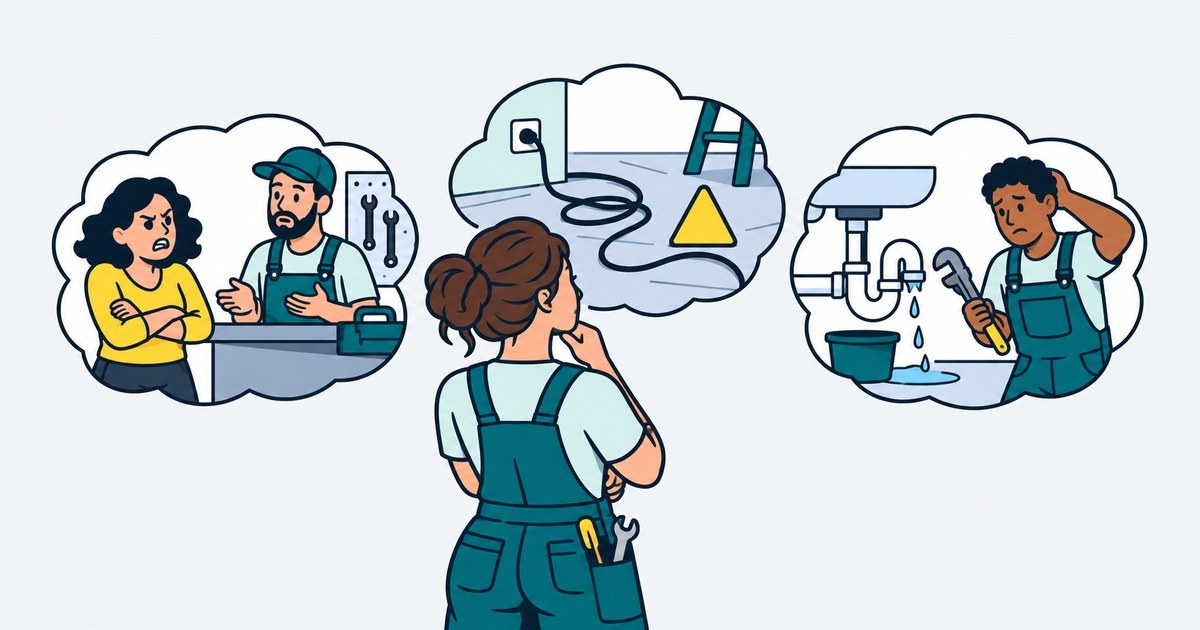
Most interview questions ask what you know. A scenario question asks what you would do. The interviewer describes a real problem at work and waits for your answer. A customer is shouting. A workmate is doing something dangerous. You have made a mistake and nobody has seen it yet.
These questions worry many tradespeople, because there is no single technical fact to remember. But one simple order of steps works for almost every scenario. This guide gives you that order, three example answers you can change to fit your trade, and the common mistakes to avoid.
What a scenario question is, and why employers ask it
A scenario question usually starts in one of these ways:
- "What would you do if…"
- "Imagine you are on site and…"
- "Tell me about a time when…"
The first two ask about a possible situation. The third asks for a true story from your own work. All three test the same thing: how you think and act when something goes wrong.
An employer who hires from another country cannot watch you work first. A scenario lets them picture you on their site on a difficult day.
For the other common questions, see the questions sponsor employers ask tradespeople.
What the employer is really checking
Your answer shows five things about you:
- Safety comes first. Do you stop and make things safe before you do anything else?
- Calm communication. Can you speak politely to a customer or a workmate under pressure?
- Honesty. Do you report problems, including your own mistakes?
- Knowing your limits. Do you know what you can decide yourself and when to ask your supervisor?
- Clear reporting. Can you tell the next person what happened and what is still to be done?
Perfect English is not on this list. Simple sentences in the right order are enough.
A four-step order that works for almost any scenario
Use the same order every time. Then you do not have to think about structure while you are nervous.
- Make it safe. Say what you would do first. If anyone could get hurt, stop the work and remove the danger.
- Find out the facts. Listen, look and ask a question. Do not guess, and do not blame anyone.
- Act and speak calmly. Do what is within your job. Say the exact words you would use.
- Report and hand over. Tell your supervisor, write it down if your workplace asks for that, and say what happens next.
A short way to remember it is: safe, facts, act, report.
The steps do not need the same amount of time. With an angry customer, step 3 is the longest. With a safety risk, step 1 matters most.
Start with "First, I would…" so the interviewer hears your order straight away.
Scenario 1: the angry customer
The scene. A customer comes to collect their car late in the afternoon. The repair is not finished because a part arrived late. The customer raises their voice and says they need the car today.
What the employer is checking. Can you stay calm, be polite and tell the truth, without making a promise you cannot keep?
An example answer. "First, I would stay calm and let the customer finish speaking. I would not argue. Then I would say, 'I am sorry your car is not ready. I understand that you need it today.' I would explain the reason in simple words: the part arrived late. Next, I would tell them what I can do. I would check the new finish time with my supervisor and phone the customer with an answer. I would not promise a time I am not sure about. After that, I would tell my supervisor about the complaint and write a note on the job card."
Why it works. The customer is heard first. The apology is short and honest. The supervisor knows about the problem before the customer phones again.
In another trade, keep the same order and change the details. Your customer may be a home owner or a site manager.
Scenario 2: the safety risk
The scene. The job is behind schedule. You see a workmate cutting steel with an angle grinder. The guard has been taken off the grinder, and he is not wearing safety glasses.
What the employer is checking. Will you speak up, even when the team is in a hurry and the other person has worked there longer than you?
An example answer. "First, I would ask him to stop the grinder. I would say it in a friendly way: 'Hold on a second. The guard is off and you have no glasses on. Let us fix that before you keep going.' I would not shout, and I would not blame him. If the guard cannot be put back, the grinder should not be used. I would put it aside and tell the supervisor. A late job can be fixed. A serious injury may last for life. Then I would report what I saw, what I did, and what still needs to be fixed."
Why it works. The danger stops in the first sentence. The words are polite, so the workmate does not feel attacked. The supervisor is told, so the same problem does not come back tomorrow.
Safety scenarios come in many forms: a spill on the floor, a damaged lead, a ladder that is not secured. The first step is always the same. For more examples, read 7 workplace safety questions you must be ready for.
Scenario 3: the mistake you made
The question. "Tell me about a time you made a mistake at work."
What the employer is checking. Are you honest? Did you report it quickly? Did you learn something?
This question needs a true story. Choose a real mistake that did not hurt anyone. Tell it in four short parts: what happened, what you did straight away, how it was fixed, and what you do differently now.
An example answer. "On one job, I cut a kitchen benchtop too short because I read the measurement wrong. I saw the mistake before the benchtop was fitted. I stopped and told my supervisor straight away. I did not try to hide it. We ordered a new piece, and I stayed late to fit it so the customer did not have to wait. Now I measure twice and mark the piece before I cut. If a drawing is not clear, I ask before I start."
Do not say, "I never make mistakes." It does not sound honest.
True stories are easier to find if you keep a record of your jobs. Some tradespeople build an online profile for showing employers their real work. The photos and notes in it will also remind you of stories you can tell.
You may also need evidence of your past work for a skills assessment in Australia. The steps depend on your trade, so check the Department of Home Affairs website for the official requirements.
Common mistakes in scenario answers
| Mistake | Why it is a problem | Do this instead |
|---|---|---|
| Starting with the repair | The interviewer hears no safety step | Say how you make it safe first |
| Blaming the customer or a workmate | It sounds like you will argue on site | Describe the facts, not the person |
| Fixing everything alone | The supervisor never finds out | Say who you tell, and when |
| Saying "I would handle it professionally" | It is too general and shows no real steps | Give real steps and the real words you would say |
| Inventing a story | Follow-up questions can show it is not true | Say it has not happened to you, then say what you would do |
How to practise scenario answers
Reading example answers is not enough. You need to say your own answer out loud, more than once.
Start at home with three scenes from your own trade: one customer problem, one safety risk and one mistake. Say each answer in about one minute. Record yourself on your phone and listen for the four steps.
Then practise with scenes you have not seen before. The Real-Life Scenarios section on InterviewTraining.ai gives you a short scene from a real job site, read by a narrator. Each scene has four questions:
- "What do you do first?" (multiple choice)
- "Safety and risk" (multiple choice)
- "What do you say?" (spoken)
- "Report and handover" (spoken)
You answer the two spoken questions out loud, with a timer. AI marking compares your answer with a model answer. It looks at the substance, not the exact words, and it allows for simple English. The feedback shows what you did well, what to add, and a stronger answer you can listen to. An unsafe step in your answer is flagged.
Speaking politely under pressure is partly about work culture. The Living & Working Here section gives you short everyday work situations and three possible replies. You see a score and an explanation for the reply you pick.
Practice does not guarantee a job. It does mean that the real interview is not the first time you answer a scenario question out loud.
Rules and requirements can change. Check the official government website before you act.
Frequently asked questions
What is a scenario question in a trade interview?
It is a question about a real work situation, such as an angry customer, a safety risk or a mistake. The interviewer wants to hear what you would do, step by step, and what you would say.
How long should my answer to a scenario question be?
About one minute is enough for most scenario questions. Give four clear steps: make it safe, find out the facts, act and speak calmly, then report. A short answer in a clear order is better than a long story.
What if the scenario has never happened to me?
Say so honestly, then explain what you would do. For example: 'This has not happened to me, but I would stop the work, make the area safe and tell my supervisor.' Do not invent a story.
Is it bad to talk about a mistake I made at work?
No. Every tradesperson makes mistakes. Choose a real mistake that did not hurt anyone. Say that you reported it quickly, explain how it was fixed, and say what you do differently now.
Can I practise scenario questions before my interview?
Yes. The Real-Life Scenarios section on InterviewTraining.ai gives you short scenes from a job site. Each scene has two multiple-choice questions and two spoken questions. The spoken answers are marked by AI, with feedback on what to add.
Topics
- Scenario questions
- Interview questions
- Workplace safety
- Tradespeople