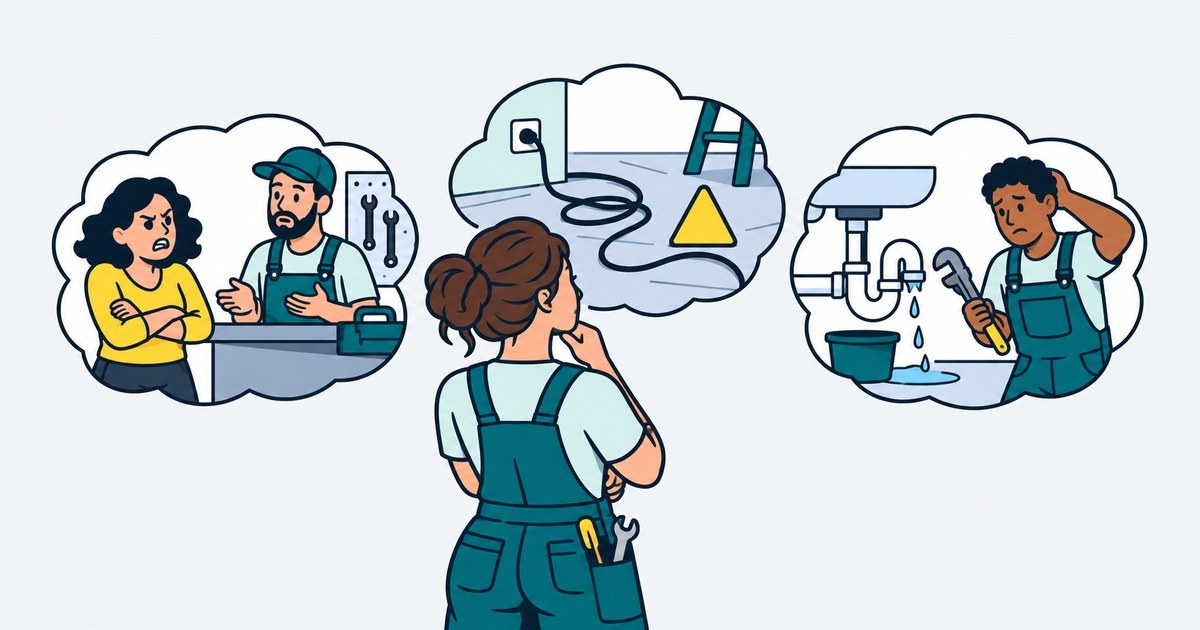
A "what would you do if" question hands you a problem at work and asks for your next move. You have no true story to tell, so the interviewer listens to the order of your actions. One order fits almost every question of this kind: stop and make it safe, tell the right person, fix it or get help, then record it. Below are the four steps and short example answers for five trades.
Why "what would you do if" questions need their own shape
You may hear these called situational, scenario based or hypothetical interview questions. The problem has not happened. The interviewer invents it to see how you think.
"Tell me about a time when..." is different. It asks for a true story. Government careers and employment websites in Australia, New Zealand, the United Kingdom and Canada all describe the STAR method for it: Situation, Task, Action, Result.
A hypothetical question has no result yet. The National Research Council Canada tells its own job candidates that behavioural questions are about real past experiences, not about what you would do in hypothetical circumstances. So skip the story and give your actions in order.
Assessors ask them too. VETASSESS, an Australian Government authorised skills assessment authority, gives sample questions for its technical interview such as "What steps would you take if you found hazardous materials on site?" and "How would you resolve a conflict with a customer or a supplier?"
The four-step method: stop, tell, fix, record
- Stop and make it safe. Say what you would stop, and say it first. If a person could be hurt, pause the work and keep people away. If nobody is in danger, "stop" means you stop the problem from growing: you do not cut, send the car out or serve the food.
- Tell the right person. Name that person: your supervisor, the site manager, the head chef or the customer. Say when: straight away, before you change anything.
- Fix it or get help. Describe the part you can do with your own training and licence. For everything else, say who you would ask.
- Record it. Finish with the paperwork your workplace uses, such as a job card, a site diary or a logbook. Then the next shift does not walk into the same problem.
Each step needs only one or two sentences. Open with "First, I would stop..." so the interviewer hears a plan. Then move on with "Then", "Next" and "After that".
How the four steps match official safety guidance in each country
The four steps are a way to speak, not a law. But they sit close to what official safety bodies ask of workers. Each country has its own rules.
| Country | What the official guidance says about workers |
|---|---|
| Australia | Safe Work Australia says workers must take reasonable care for their own health and safety and that of others. In some circumstances a worker has a right to stop or refuse unsafe work if they have a reasonable concern of a serious risk. They must tell the business as soon as they can and be available for suitable alternative work. |
| New Zealand | WorkSafe says a worker has the right to stop or refuse work if they believe it would expose them or anyone else to a serious risk from an immediate or upcoming hazard. They must let the business know as soon as they can. |
| United Kingdom | The Health and Safety Executive (HSE) says workers must take care of their own health and safety and that of others. Construction workers must report any risks they find to whoever controls the work on site. |
| Canada | The Canadian Centre for Occupational Health and Safety lists three basic rights of workers: to know about health and safety matters, to take part in decisions, and to refuse work that could affect their health and safety and that of others. |
For more detail, read about duties under Australia's model work health and safety laws or the HSE's summary of health and safety law in Great Britain. You do not need to quote a law in an interview. One calm sentence is enough: "I would stop and tell my supervisor straight away."
"Fix" does not mean "put on more safety gear"
Gloves and glasses are not a full answer. Australia's model Code of Practice for construction work sets an order. First eliminate the hazard. Then substitute something safer, isolate the hazard from people or use engineering controls. After that come administrative controls. Personal protective equipment (PPE) is last, for any risk that remains. The code calls PPE the lowest order control and says it does nothing to change the hazard itself.
In New Zealand, WorkSafe says PPE should not be the first or only control considered. So in step three, say how you would remove or reduce the danger before you mention safety gear.
Five short worked examples from different trades
These are examples only. Change the details to match your own work.
Scenario questions are one part of a trade interview. For questions about a job you have done, your tools or a fault you fixed, see our guide to trade job interview questions and answers.
Motor mechanic: a fault nobody asked about
"What would you do if you saw a leaking brake hose during an oil change?"
A simple answer could be: "First, I would stop and keep the car on the hoist. Then I would show the hose to my supervisor. Next, once the customer agrees, I would replace the hose and test the brakes. After that, I would write the fault and the customer's decision on the job card."
Electrician: damage outside your job
"What would you do if you opened a switchboard in a house and saw burn marks?"
A simple answer could be: "First, I would stop and touch nothing that may be live. Then I would warn the customer and phone my supervisor. Next, I would isolate the circuit and prove it is dead, if my licence and the site rules allow that. After that, I would take a photo for the job record."
Welder: a drum with an unknown past
"What would you do if you had to weld a drum and nobody knew what it had held?"
A simple answer could be: "First, I would not strike an arc, because an empty drum can still hold vapour that burns. Then I would tell my supervisor why I cannot start. Next, I would ask for the safety data sheet, and for a trained person to clean and check the drum. After that, I would raise it at the pre-start meeting."
A safety data sheet (SDS) is the document that explains how to handle a product safely.
Carpenter: the drawing and the site do not match
"What would you do if your measurement on site was different from the drawing?"
A simple answer could be: "First, I would stop before I cut any timber. Then I would measure again and show the site supervisor both numbers. Next, I would wait for a decision, because other trades build from the same drawing. After that, I would note the change and who approved it in the site diary."
Cook: the cool room is warm
"What would you do if you started your shift and the cool room was not cold?"
A simple answer could be: "First, I would stop anyone from using food out of that cool room. Then I would tell the head chef straight away. Next, I would follow the kitchen's food safety plan and ask for a technician to be called. After that, I would write the time and the temperature in the kitchen log."
For three longer answers, read our post on the angry customer, the safety risk and the mistake you made.
What to say when you need time or do not understand
A long scenario in a second language is hard to follow. Tahatū, the New Zealand Government's careers website, says you can take time to think and might say, "Oh, good question – let me think about this one." Canada's Job Bank says it is better to ask for clarification than to answer inappropriately.
- "Could you say the question again, please?"
- "Am I working alone, or is a supervisor on site?"
A checking question shows that you look before you act. If grammar worries you, read why imperfect English is fine in a trade interview.
Common mistakes with "what would you do if" answers
- Starting with the repair. The interviewer hears no "stop" and no "tell".
- Saying "it depends" and nothing else. Choose the most likely case, say which one, and answer it.
- Inventing a past story. You do not need one. If it did happen to you, add one true line.
- Making PPE the whole answer. Remove or reduce the danger first.
- Being the hero. Fixing work outside your licence without telling anyone worries an employer.
- Forgetting the record. One sentence about the job card or the logbook closes the answer.
Practise the four steps out loud
Write down five problems from your own trade. For each one, note what you stop, who you tell, what you fix and where you record it. Then speak the full answer without reading.
On InterviewTraining.ai, Real-Life Scenarios is the practice section for "what would you do if" situations. You answer out loud and get a score from 0 to 10, with what you did well, what to add and a stronger answer. The marking does not take marks off for your accent, small grammar mistakes or simple words.
After that, try a full mock interview, or use Skills Practice for the technical side of your trade. Many scenarios are about safety, so our list of workplace safety questions for an overseas trade interview is a good next read.
Practice helps you prepare. It does not promise a job, a visa or a pass in a skills assessment.
Rules and requirements can change. Check the official government website before you act.
Frequently asked questions
What is a "what would you do if" interview question?
It is a question about a problem that has not happened yet. The interviewer describes a difficult moment at work and asks for your next move. Other names are situational or hypothetical questions.
Should I use the STAR method for a "what would you do if" question?
Not as your main shape. STAR is built for true stories from your past. A hypothetical question has no result yet, so give your actions in order: stop, tell, fix, record.
What if the scenario is not about safety?
The same four steps still fit. "Stop" then means you stop the problem from growing, for example by waiting before you cut, send out a car or serve a meal.
What if I do not know the technical answer to the scenario?
Say so calmly, then show safe thinking. For example: "I have not used that system before. I would stop and ask my supervisor to show me before I start."
Can I say that I would refuse to do unsafe work?
Yes, if you say it calmly. Official guidance in Australia and New Zealand describes a right to stop or refuse unsafe work when there is a serious risk. Add that you would tell your supervisor straight away.
Key takeaways
- A "what would you do if" question tests the order of your actions, not a story from your past.
- Use four steps every time: stop and make it safe, tell the right person, fix it or get help, record it.
- Keep STAR for "Tell me about a time" questions.
- In step three, remove or reduce the hazard first. Safety gear comes last.
- Safety rules differ by country, so speak about the country where the job is.
Topics
- scenario questions
- interview questions
- what would you do if
- situational questions
- workplace safety
- tradespeople