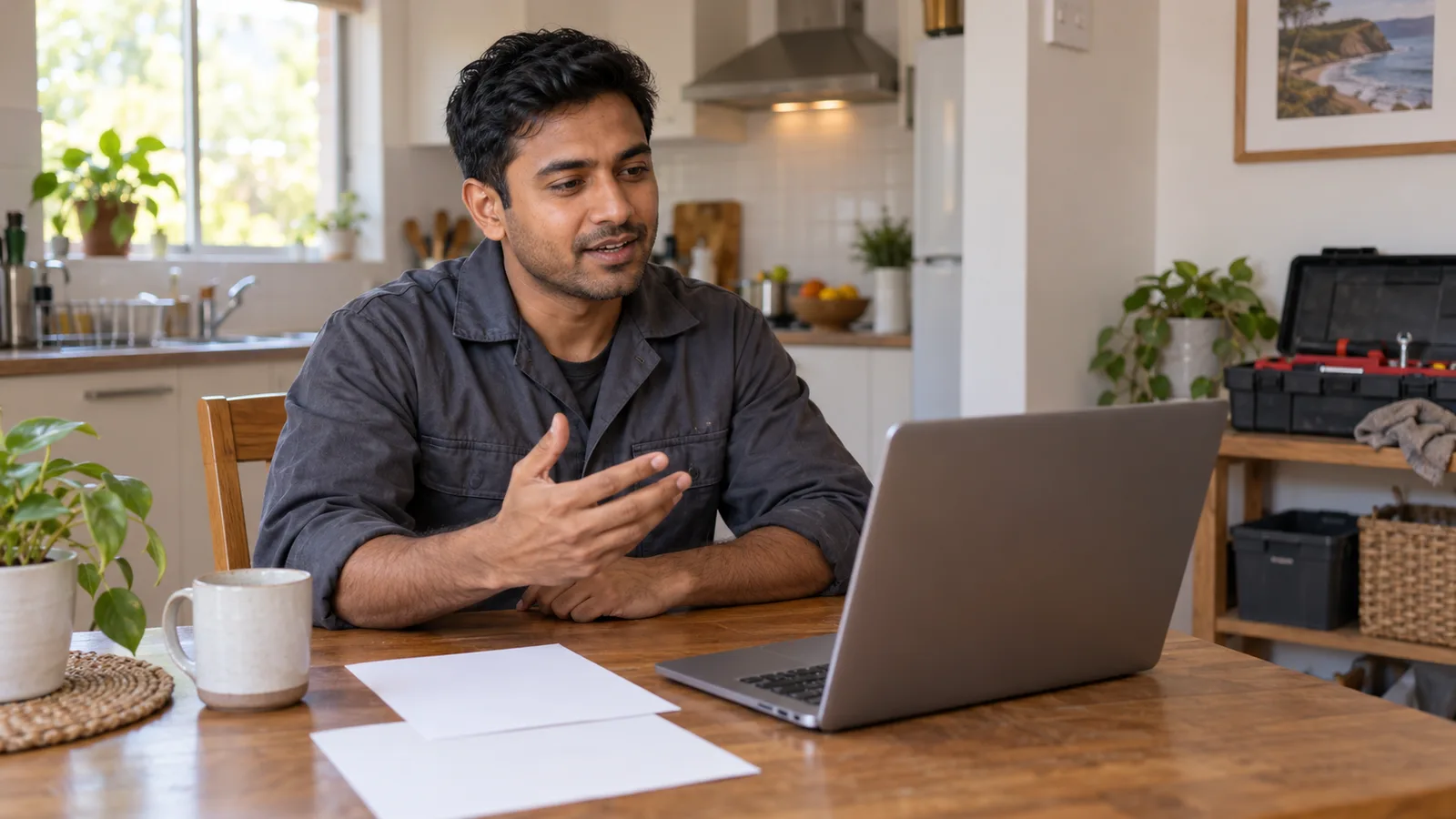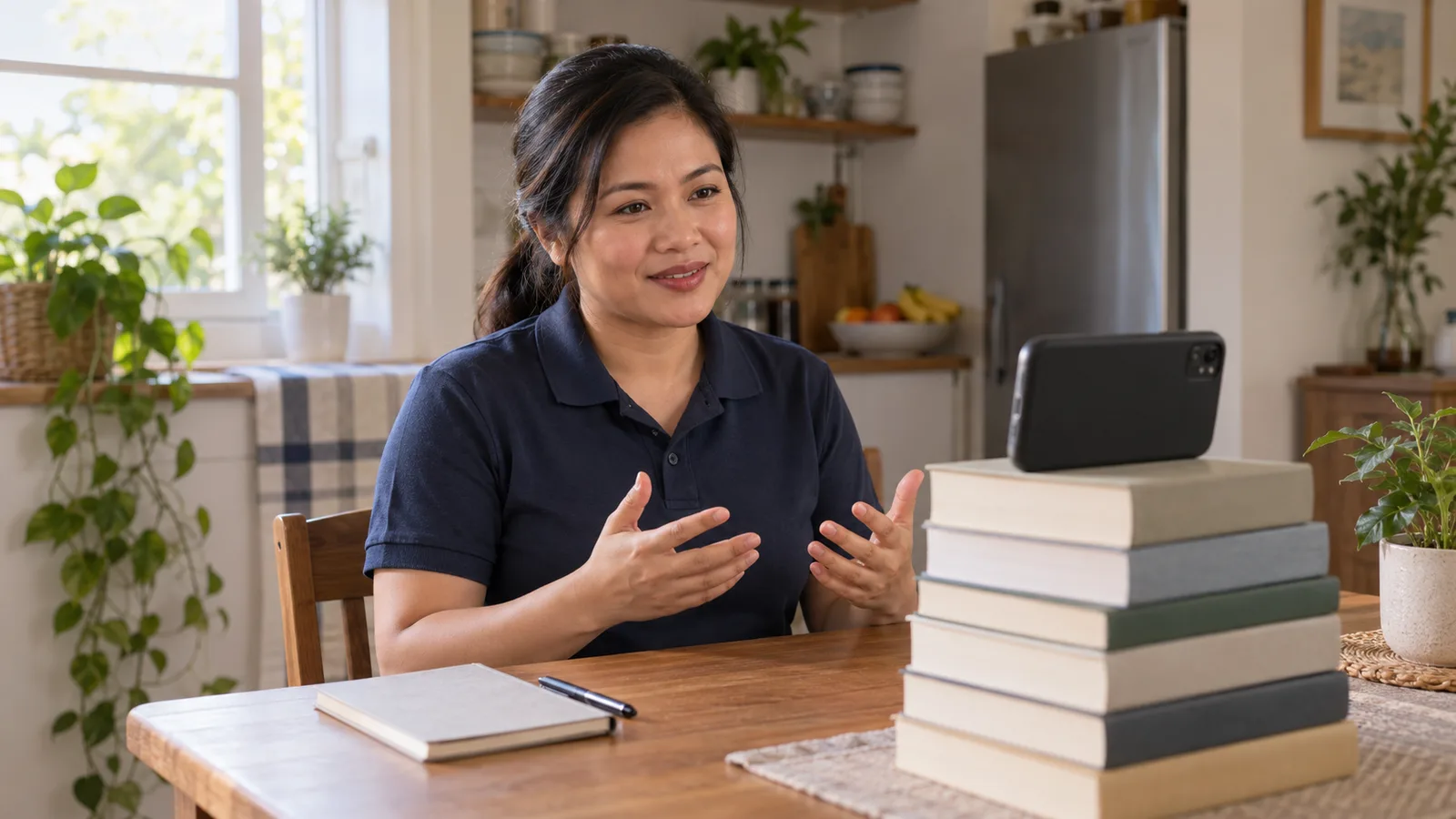
Good body language in an interview is simpler than most guides make it. Greet the interviewer with a smile, sit upright, keep your hands relaxed, look at the person who is talking to you, and speak a little slower than you normally do. You do not have to act like a different person. Interviewers in Australia, New Zealand, the United Kingdom and Canada mainly want to see that you are listening, that you are interested in the job, and that you would be easy to work beside. This guide covers each part, in person and on camera.
Why body language is harder in a second language
When you search for an English word, your body changes without you noticing. Your eyes drop to the floor. Your face goes flat. Your shoulders lift, and your hands start to fidget or hide.
The interviewer may then think you are unsure about the work, when you are only unsure about one word.
You do not need perfect body language, in the same way that you do not need perfect English for a trade interview. A few steady habits are enough.
Fair interviewers are also told to be careful. The Australian Human Rights Commission tells interviewers in its recruitment guide not to make assumptions from behaviour or body language that may come from a person's cultural background. Its example is a person who does not shake hands, who may be showing the appropriate respect within their culture.
What interviewers in these four countries usually expect
Customs are different around the world, and no custom is the wrong one. In some countries you show respect to a senior person by looking down and speaking softly. In Australia, New Zealand, the UK and Canada, most interviewers read a steady look and a clear voice as signs of interest and honesty. You are not giving up your own manners. You are learning the local ones.
Greetings and pace also change from country to country. Our guide to interview etiquette in Australia, New Zealand, the UK and Canada compares them side by side.
The Canadian Government's Job Bank gives a short list in its advice on preparing for an interview: greet the interviewer or the panel, introduce yourself, shake hands firmly, smile, stand until you are invited to sit down, make eye contact, and answer in a firm, clear, confident voice. The table turns that list into small actions.
| Part | What most interviewers expect | A simple way to do it |
|---|---|---|
| Greeting | A smile, your name, and a short handshake if one is offered | Say "Good morning", then your first name |
| Sitting | Upright and still, but not stiff | Back against the chair, both feet on the floor |
| Eyes | You look at the person who is speaking | Watch their face while they ask, and for most of your answer |
| Hands | Calm, open and easy to see | Rest them on your lap, and use them to explain |
| Face | Friendly and awake | Smile at the start and the end |
| Voice | Clear and unhurried | Slow down, and finish each sentence |
The first two minutes: arriving and greeting
These steps keep the start calm.
- Get there early. The Australian Government's advice for job seekers is to aim to arrive 10 to 15 minutes early in case of unexpected delays. Use the spare minutes to breathe slowly.
- Turn your phone off and put it away. The UK's National Careers Service lists this as a step for the day.
- Stand up when the interviewer comes to you. Face them, smile, and say your name slowly.
- Follow their lead on the handshake. If a hand is offered and you are comfortable, give a firm, short handshake. Firm means a full grip, not a hard squeeze. If you do not shake hands for religious or cultural reasons, place your right hand on your chest, give a small nod and a smile, and say "It is very nice to meet you."
- Wait to be shown your seat. Stay standing until you are invited to sit, then put your folder down so that your hands are free.
How to sit in an interview
Sit with your back touching the back of the chair and both feet flat on the floor. Lean forward a little when the interviewer is talking. That small lean shows you are listening.
Keep your arms uncrossed. Crossed arms may only mean you are cold or nervous, but to many interviewers in these countries they look closed or unhappy.
Eye contact in an interview: how much is enough
Eye contact worries people most, so here is a plain rule. Look at the interviewer's face while they are asking the question. When you answer, look at them for most of the time, and let your eyes move away for a moment when you need to think.
If a direct look into the eyes feels too strong for you, look at the space between the person's eyebrows. From across a desk, it reads as eye contact. Do not stare without a break either.
With a panel (two or more interviewers together), begin your answer to the person who asked, look at each of the others for a sentence, and finish with the person who asked.
Hand gestures in an interview
Your hands are a strength. People in trades explain with their hands all day: the size of a part, the direction of a cut, the order of a job. Do the same in the interview. When a word will not come, a clear gesture can carry the meaning.
- Keep gestures in front of your body, between your waist and your shoulders.
- Show open palms rather than a pointing finger. Never point at the interviewer.
- Leave the pen alone. Clicking and tapping are what an interviewer remembers.
- Keep your hands away from your mouth, because they block your voice.
Your face and your voice
Nod only when you have truly understood. Canada's Job Bank says it is better to ask for clarification than to answer inappropriately. Lean in a little and say: "Sorry, could you say that again, please?"
New Zealand's government careers site, Tahatū, tells candidates to speak clearly and to take time to think about a question. It even offers a sentence that buys you the time: "Oh, good question – let me think about this one." A pause after that sentence looks confident, not slow.
Nervous speakers get faster. Do the opposite: slow down, and keep your voice up until the last word of each sentence.
The UK's National Careers Service suggests speaking in a conversational way so that you do not appear too rehearsed. Learn your ideas, not a script. Our guide to answering "Tell me about yourself" in any trade shows one way to prepare.
Body language on a video interview
Many overseas interviews happen on a screen, and the camera changes the rules.
Tahatū's tips for video and phone interviews say to place the device at eye level, make sure your face is well lit, and look at the camera to make virtual eye contact. An Australian Government careers guide gives the same advice in other words: look at the camera rather than at yourself or the interviewers, and dress appropriately even for a video interview.
- Stand your phone against something solid and turn it sideways. A phone held in the hand shakes.
- Nod a little more clearly than you would in a room, because small nods disappear on a small screen.
- Wait one breath before you answer. An internet delay can make a fast answer sound like an interruption.
- Be in your seat and ready 5 to 10 minutes before the start, as the UK's National Careers Service advises.
For the technical side, use our camera, sound and internet checklist for a video interview from overseas.
Common mistakes with interview body language
- Looking at the floor while you search for a word. Look slightly up or to the side instead, then come back to the interviewer.
- Nodding when you did not understand. Ask for the question again. It shows care, not weakness.
- Squeezing too hard in the handshake. Firm and short is enough.
- Watching your own picture on a video call instead of the camera.
- Rushing to finish the answer so that the English part is over sooner.
- Trying to fix everything at once. Choose two habits for this week, such as feet flat and eyes up.
How to practise body language out loud
Record yourself on your phone answering one easy question. Watch it first with the sound off, and look only at your eyes, hands and shoulders. Then watch it with the sound on and listen to your speed. Pick one thing to change and record again.
The Australian Government's advice for job seekers also says it can help to practise your answers with someone you trust. Ask that person where your eyes went, not whether your grammar was right.
On InterviewTraining.ai you watch an interviewer ask a question on video and then answer out loud. The self-view camera is optional and is a preview that only you can see, so you can use it to check your posture and where you are looking. The marking does not take marks off for your accent, small grammar mistakes or simple words.
Our Interview Presence practice section is coming soon. Until it opens, build the habits with the personal questions in General Practice, then test them under pressure in a full Mock Interview. Practice builds habits. It cannot promise the result of any interview.
Frequently asked questions
Is it rude to refuse a handshake in an interview?
It is not rude if you greet the interviewer warmly in another way, such as a smile, a small nod and a hand on your chest. The Australian Human Rights Commission tells interviewers not to make assumptions about a person who does not shake hands.
How much eye contact should I make in an interview?
Look at the interviewer while they ask the question and for most of your answer. It is normal to look away for a moment while you think. Avoid long looks at the floor, and avoid staring without a break.
What should I do with my hands in an interview?
Rest them loosely on your lap or on the table, where they can be seen. Use them to explain sizes, directions and steps, as you would at work. Do not point at the interviewer or play with a pen.
Where should I look during a video interview?
Watch the screen while the interviewer is speaking, and look at the camera lens while you are speaking. Government careers advice in both Australia and New Zealand says to look at the camera.
Does body language matter if my English is not strong?
Yes, and it can work in your favour. A calm posture, a steady look and clear gestures show that you are listening and that you know your trade, even when one word is missing.
Key takeaways
- Interviewers in these four countries usually expect a smile, an upright seat, a steady look and a clear voice.
- Arrive 10 to 15 minutes early and use the time to settle your breathing.
- Look at the interviewer while they ask and for most of your answer, and look away only briefly to think.
- On video, watch the screen when you listen and the camera when you speak.
- Practise out loud and on camera until the habits feel normal.
Topics
- body language
- interview tips
- eye contact
- video interview
- interview presence
- english as a second language