You have fixed cars for years. You can find a fault with your hands, your eyes and your ears. Now someone in Australia wants you to explain it in English, often on a video call. That is a different skill.
A skills interview, also called a technical interview, is a conversation about how you do your trade. For a motor mechanic it covers servicing, fault finding, repairs, tools and safety. This guide explains who may interview you, what they usually ask, and how to give clear answers. It is a general guide. It does not describe the process of any one employer or organisation, so always read the instructions you are given.
Who might interview you, and why
Three kinds of people may ask you technical questions.
- An employer or workshop manager. They want to know if you can do the work in their workshop.
- A recruiter. They check your experience before they send your details to an employer. Some recruiters focus on overseas jobs for tradespeople.
- A skills assessor. Some pathways to working in Australia ask for a formal skills assessment. It may include a technical interview.
A skills assessment is a formal check of your trade skills and experience. The steps, documents and costs depend on your trade, your pathway and the organisation that does it. You can read more about skills assessment in Australia. Always confirm what applies to you on the Department of Home Affairs website.
The questions are similar in all three cases. The person wants to hear that your experience is real.
What the interview usually covers
Every interview is different, but these areas are common for a mechanic who works on cars and light vehicles.
| Area | Example question | What they are checking |
|---|---|---|
| Your experience | What vehicles do you work on most? | Your experience is real and recent |
| Servicing | Talk me through a full service | You work in order and miss nothing |
| Fault finding | An engine cranks but will not start. What do you check? | You test in a logical order |
| Brakes, steering and suspension | How do you replace front brake pads? | You know the steps and the final checks |
| Electrical | How do you test a battery and the charging system? | You can use a multimeter and read the result |
| Tools and equipment | What do you use a torque wrench for? | You know tool names and their purpose |
| Safety | How do you lift a vehicle safely? | Safety is a habit, not an extra |
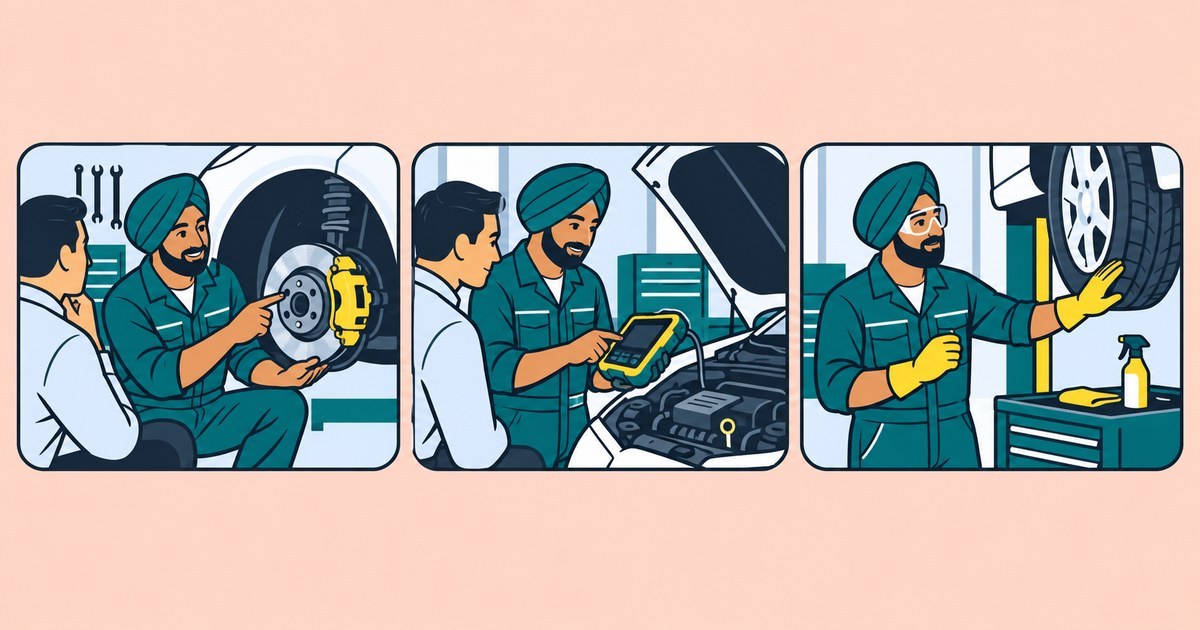
You may also be shown a picture of a part or a job and asked to explain it.
How to answer the two main types of question
Many technical questions are one of two types: "How do you do this job?" or "How do you find this fault?"
Type 1: a step-by-step job
Question: "How do you replace front brake pads?"
Example answer: "First I make the car safe. I lift it on the hoist at the correct lifting points and check that it is stable. Then I remove the wheel and look at the pads, the disc and the brake hose. I undo the caliper bolts and support the caliper, so it does not hang on the hose. I take out the old pads and push the piston back. I fit the new pads and tighten the bolts to the manufacturer's specification. Finally I refit the wheel, pump the brake pedal until it is firm, check the fluid level and road test the car."
Why this answer works:
- Safety comes first.
- The steps are in the order you really do them.
- It ends with checks and a road test.
- It refers to the manufacturer's specification and does not guess a number.
Type 2: finding a fault
Question: "A petrol engine cranks but will not start. What do you check?" Here "cranks" means the engine turns over when you turn the key.
Example answer: "First I ask the customer what happened and when. Then I do the simple checks: fuel in the tank, battery voltage and warning lights. I connect a scan tool and read any fault codes. After that I check what the engine needs to run: fuel pressure, spark and air. I test each one. I do not guess. When I find the cause, I repair it, clear the codes and start the car several times to be sure."
The interviewer is checking that you start with simple things. They also want to hear that you test before you replace parts.
Safety questions to expect
Expect safety questions in any technical interview. Be ready to talk about these:
- Lifting a vehicle. Use the correct lifting points and check that the vehicle is stable. Never work under a vehicle held only by a jack. Use safety stands.
- Personal protective equipment (PPE). This is the safety gear you wear, such as safety glasses, gloves, safety boots and hearing protection.
- Electrical work. Say when you disconnect the battery and why.
- Hybrid and electric vehicles. They have high-voltage parts. Say that you only work on them if you are trained. Say that you follow the manufacturer's procedure to make the system safe first.
- Fluids. Clean up spills straight away. Dispose of used oil and coolant the correct way.
If you see something unsafe, the right answer is to stop and tell your supervisor. For more, read the workplace safety questions you must be ready for.
Car words that may be different in Australia
Australian workshops use many British car words. If you learned American English, some of these may be new:
- Bonnet: the cover over the engine (hood).
- Boot: the storage space at the back of a car (trunk).
- Windscreen: the front glass (windshield).
- Spanner: a hand tool for nuts and bolts (wrench).
- Petrol: gasoline.
- Hoist: the machine that lifts a vehicle in a workshop.
- Ute: a vehicle with an open tray at the back for carrying loads.
- Tyre: spelled with a "y" in Australia.
There are more in Australian trade words that confuse new arrivals.
Common mistakes in a skills interview
- Skipping steps you do without thinking. Say every step, even the easy ones.
- Changing parts before testing. Always say how you confirm the fault first.
- Forgetting the end of the job. Mention the final check, the road test and the paperwork.
- Guessing numbers. If you do not remember a setting, say you check the service manual.
- Claiming experience you do not have. It is better to say, "I have done that only a few times, but this is what I know."
- Having no proof. Photos and short videos of your real work help. You can show employers your work and skills in one place before the interview.
A simple practice plan
- Write a list of ten jobs you do often, such as a service, a brake job or a battery test.
- For each job, write the steps as key words only.
- Add the safety step at the start and the final check at the end.
- Say each job out loud with a timer. Aim for about one minute.
- Ask a friend to choose a job from the list without warning you.
Do a few jobs each day. A little practice each day is easier to keep up than one long session the night before.
Practise technical answers on InterviewTraining.ai
Skills Practice gives technical questions for your trade, grouped by skill. You pick up to three skills. An interviewer video asks the question, and some questions show a picture of the job. Then you answer out loud.
AI marking compares your answer with a model answer. It looks at the substance, not the exact words, and it gives full credit for a valid different method. If your answer has an unsafe step, the feedback flags it. You also see what to add and a stronger answer.
Check the trades page to see which trades have questions now. Our Australia page has more about interview practice for that country.
It is practice only. We are not linked to any government, assessing body or employer, and practice cannot promise a result. It can help you walk in ready to explain your work.
Rules and requirements can change. Check the official government website before you act.
Frequently asked questions
What is a skills interview for a motor mechanic?
It is a conversation where you explain how you do your trade work. You may be asked about servicing, fault finding, brakes, electrical checks, tools and safety. The aim is to hear that your experience is real.
Do I need a skills assessment to work as a mechanic in Australia?
It depends on your pathway and your own situation. We cannot tell you what applies to you. Check the Department of Home Affairs website and the official assessing organisation for your trade before you act.
What if my method is different from the Australian method?
Explain your method clearly and say why you do each step. A different method can still be correct if it is safe and follows the manufacturer's instructions. Say that you follow workshop procedures and the service manual.
Should I give exact torque settings and measurements in my answer?
Only if you are sure. It is better to say that you check the manufacturer's specification for that vehicle. This shows good habits, because settings are different for each make and model.
Does InterviewTraining.ai have questions for motor mechanics?
Skills Practice gives technical questions by trade, and the trades page shows which trades have questions now. General Practice has personal questions for your destination country, so it is useful for every trade.
Topics
- Motor mechanic
- Skills interview
- Australia
- Technical questions