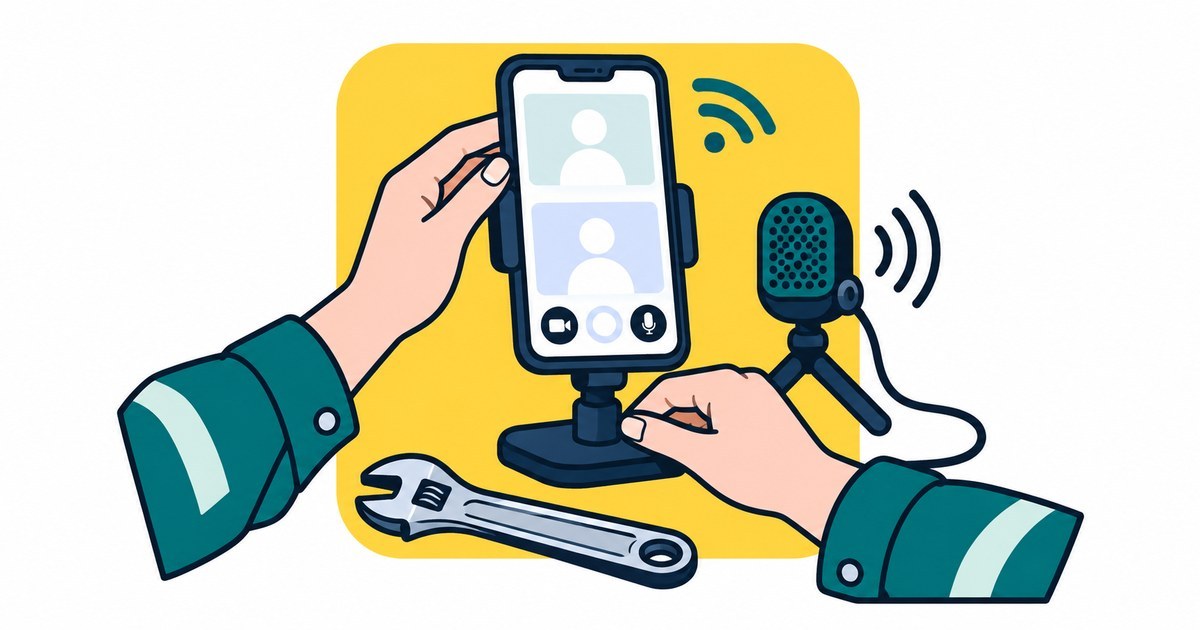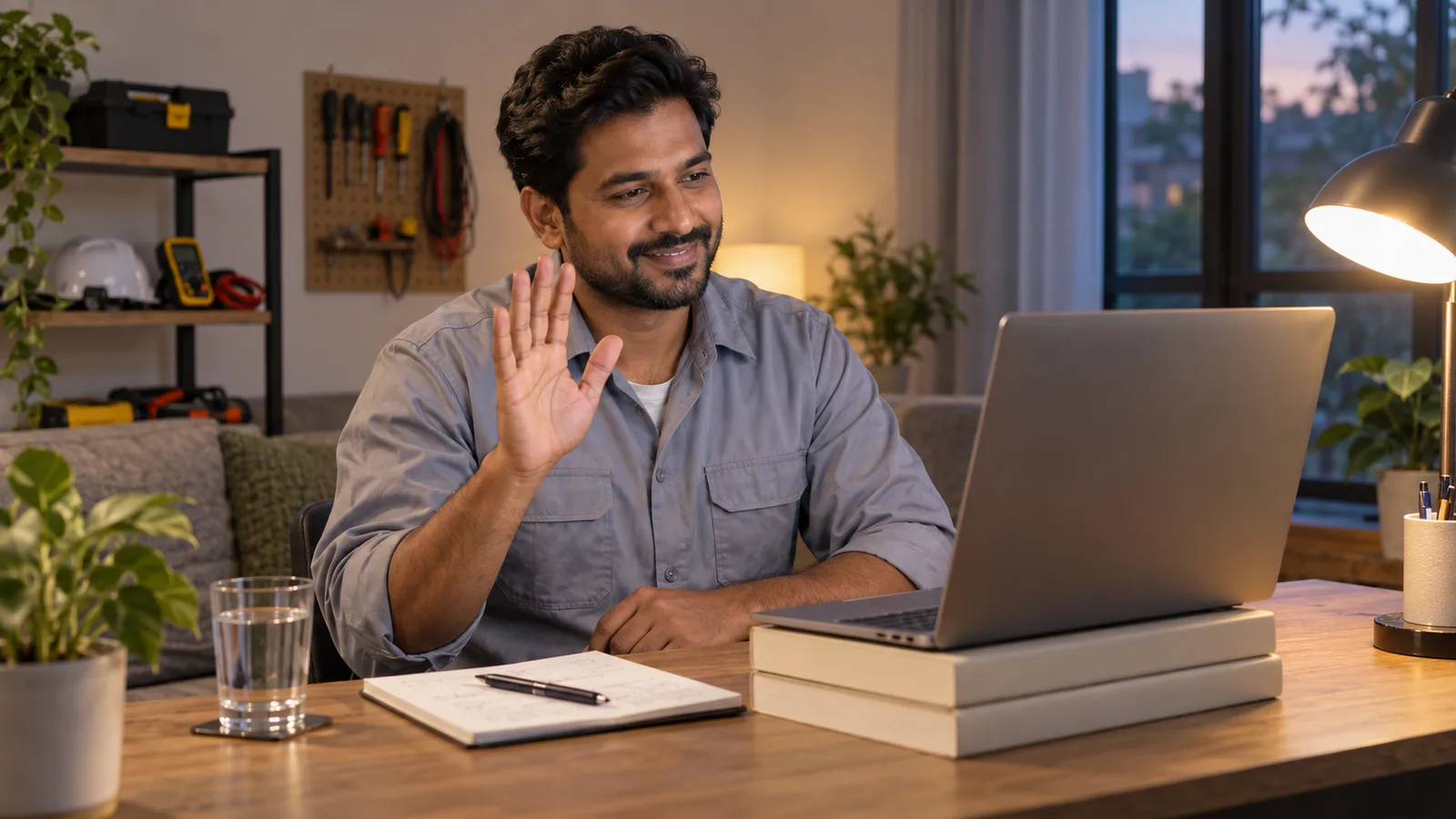
The best online interview tips are about your words, not your equipment. An online interview runs in the same order almost every time: you join, you greet, you answer, you ask, and you say goodbye. Join early, greet the interviewer by name, look at the camera and speak slowly. Ask for a question again if you missed it, give one real example in each answer, and finish with thanks and a question about the next step.
For equipment, use our video interview checklist for the camera, sound and internet first.
The online interview in seven stages
A video interview with an employer usually moves through seven stages. Each one is easier with a sentence ready.
| Stage | What you do | A sentence you can use |
|---|---|---|
| The invitation | Confirm the time and ask what to expect | "Will there be a test during the interview?" |
| The practice call | Rehearse the whole conversation with a friend | "Was I too fast? Did I talk over you?" |
| Joining | Open the link early and wait quietly | "Can you see and hear me clearly?" |
| The first minute | Greet, give your name and say thank you | "Thank you for meeting me today." |
| The questions | Listen, pause, then answer with one example | "Let me give you an example from my last job." |
| Your questions | Ask two questions you wrote down earlier | "What does a typical day involve?" |
| The goodbye | Say thanks and ask about the next step | "When can I expect to hear from you?" |
Before the call: reply well and rehearse out loud
Your interview starts with your reply to the invitation.
The UK's National Careers Service interview advice says to find out whether the interview is in person, by phone or by video, and to know how to contact the interviewer if you are running late. Canada's Job Bank adds that you can ask if there will be a test and how many people will be there. A short reply could be:
"Thank you for inviting me to an interview for the diesel mechanic job. I confirm Tuesday at 9 am, your time. May I ask who I will speak with, and whether there will be a test? If the call fails, which phone number or email should I use?"
Next, get your words ready. New Zealand's Tahatū Career Navigator advises thinking of examples that show how you have used your skills. For a trade interview, that means three or four short work stories: a fault that was hard to find, an unsafe job you stopped, a job you finished under time pressure. Prepare the opening answer too, with our guide to a 60-second answer to "Tell me about yourself".
Then rehearse. Tahatū's advice on video and phone interviews includes testing your camera, microphone and internet connection with a friend beforehand. Use that same call to practise the conversation. Ask your friend to play the interviewer while you join, greet, answer two questions, ask one question and say goodbye.
Joining the call and the first minute
The first minute sets how calm you feel for the rest of the interview. Follow these steps in order.
- Be at your screen early. The Australian Human Rights Commission's IncludeAbility guide to preparing for an interview suggests allowing at least 30 minutes before the start to check your technology and background. The National Careers Service says to be ready to start 5 to 10 minutes before the time.
- Clear your table. Tahatū advises silencing your devices and keeping your CV, your interview notes, a pen and paper and a glass of water near you.
- Greet first. Smile and say: "Good morning. My name is [your name]. Thank you for meeting me today." Use the name the interviewer signed in their email. Then check the line: "Can you see and hear me clearly?"
- Answer the small talk. Many interviewers open with "How are you today?" Give a short, friendly answer and return it: "I am well, thank you. How is your day going?"
- Write down the names. If two or three people are on the call, note each name. You will need the names for your goodbye.
Eye contact is different on a call. Tahatū says to look at the camera to make virtual eye contact. Do not watch your own picture.
The interviewer may ask to record the call. In the UK, guidance for employers from Acas says an employer who needs to record an online interview must get the person's permission first. A simple reply is: "Yes, that is fine with me."
Answering on camera: sentences for the hard moments
You do not need perfect English to answer well. You need a few safe sentences for the moments that make people panic.
Tahatū's tips are to speak clearly, take time to think, ask for a question to be explained or repeated if you do not understand it, give examples from your experience, and keep answers brief and to the point. Job Bank's interview preparation advice says it is better to ask for clarification than to answer inappropriately. So asking is not a weakness.
| The moment | What you can say |
|---|---|
| You missed part of the question | "I am sorry, I missed the last part. Could you repeat the question, please?" |
| You heard a word you do not know | "I do not know the word 'rework'. Could you explain it another way?" |
| You need time to think | Tahatū suggests: "Oh, good question – let me think about this one." |
| The question has several parts | "May I write that down? I will answer the first part, then the second." |
| You both speak at the same time | "Sorry, please go ahead." |
Build every story the same way
Government career advice in New Zealand, the UK, Canada and Australia all points to one method for questions about something you have done. It is called STAR: Situation, Task, Action, Result.
A simple answer from a welder could be: "At my last workshop, a trailer frame came back with a cracked weld. My supervisor asked me to find the cause and repair it. I ground out the old weld, cleaned the joint and welded it again. The frame passed inspection."
Notice the word "I". Canada's National Research Council tells its own job candidates to use "I" statements and not "we" statements. Many tradespeople say "we" out of respect for the team, but the employer needs to hear what you did.
On a call, the interviewer cannot always tell when your answer is over. Close it with a clear last line, such as "That is how I fixed it." Then stop, smile and wait.
Showing documents and photos of your work
On a video call nobody can watch you weld. The employer may ask you to describe a job step by step, or to show photos and documents instead.
Put five or six clear photos and your trade papers in one folder on your device. Then use sentences like these:
- "I have photos of a switchboard I wired last month. May I show them?"
- "I am sharing my screen now. Can you see the photo?"
- "I will hold my trade certificate up to the camera. Please tell me if it is not clear."
Describe each photo in three short sentences: what the job was, what you did, and how it ended. Hide customer names and addresses before you show anything.
Your questions and the goodbye
The National Careers Service says you will usually have time towards the end to ask your own questions, and that it is important to write them down before the interview. Tahatū suggests asking about the type of work you will be doing, training and progression, and what the people and team are like.
Two questions are enough. You could ask: "What kind of jobs come into the workshop most weeks?" and "Will there be any training after I start?"
A goodbye could be: "Thank you for your time today. I am very interested in this job. When can I expect to hear from you?" After the reply, say "Thank you. Goodbye," and smile. Let the interviewer close the call, and check that it has really ended before you speak to anyone in the room.
Tahatū advises sending an email the next day to thank the interviewer and writing down the questions you were asked. Our guide on what employers check between the job offer and your first day covers what comes next.
Common mistakes in an online interview
- Reading answers from the screen. Your eyes move and your voice goes flat. The National Careers Service says to speak in a conversational way so you do not appear too rehearsed.
- Talking over the interviewer. Video calls carry a short delay. Count "one" in your head before each answer.
- Saying "we" in every answer. The employer is hiring you, not your old team.
- Complaining about an old boss. The Australian Government's advice for job seekers warns against criticising any of your past employers, because it can reflect poorly on you.
- Dressing for the sofa. The Australian Government's Your Career guide for school leavers says to dress appropriately even for a video interview.
Practise the whole call out loud
On InterviewTraining.ai you watch an interviewer ask a question on video and answer out loud. You get a score from 0 to 10 with what you did well, what to add, and a stronger answer.
The answer timer follows the English level you choose: 90 seconds at Foundation, 75 at Working and 60 at Fluent. This trains you to keep answers brief. The marking does not take marks off for your accent, small grammar mistakes or simple words.
Begin with General Practice for personal questions. When those feel easy, sit a Mock Interview from the first question to the last. The Interview Presence section is coming soon.
This is practice only. InterviewTraining.ai is not linked to any government, visa authority, skills-assessment body or employer.
Frequently asked questions
How early should I join an online interview?
The Australian Human Rights Commission's IncludeAbility guide suggests at least 30 minutes to check your technology and background. The UK's National Careers Service says to be ready 5 to 10 minutes before the start.
Can I ask the interviewer to repeat a question?
Yes. Official career advice in New Zealand, the UK and Canada says you can ask for a question to be repeated or explained. Canada's Job Bank says it is better to ask for clarification than to answer inappropriately.
Can I use notes during an online interview?
Yes, short notes are fine. Tahatū advises keeping your CV and interview notes near you, and the National Careers Service says you might refer to your notes before answering. Do not read full answers from them.
How do I end an online interview politely?
Thank the interviewer for their time, say you are interested in the job and ask when you can expect to hear back. Say goodbye, smile and let the interviewer close the call.
Key takeaways
- An online interview has seven stages. Prepare one sentence for each of them.
- Reply to the invitation clearly and ask about tests, people and a backup contact.
- Be early, greet first, look at the camera and pause before each answer.
- Asking for a question again is normal, and official advice supports it.
- Use one real example in each answer, and say "I", not "we".
Topics
- online interview tips
- video interview tips
- virtual interview
- interview phrases
- tradespeople
- overseas interview