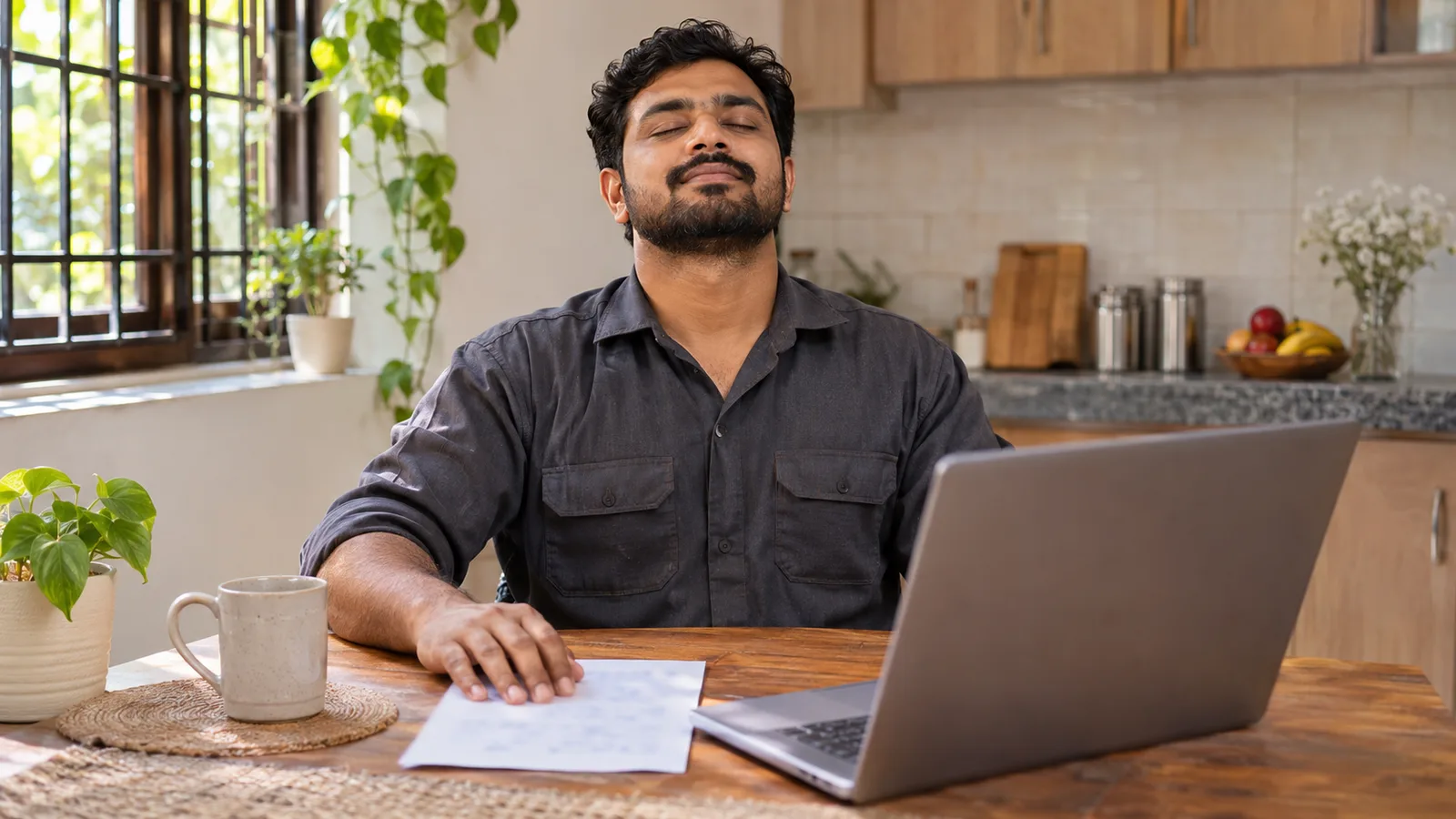
To calm nerves before an interview, give your mind a plan for the last hour: choose your first sentence, breathe slowly, read one page of notes and say your main answers out loud once. You will not feel zero nerves, and you do not need to. You need the first minute to go smoothly, because after that most people relax.
This guide is for tradespeople who speak English as a second language. It gives you a simple routine you can use before a phone call, a video interview or a meeting at a workshop. It makes no medical promises: it is practical coaching, the kind a good foreman would give you.
Why English as a second language makes nerves feel bigger
When you speak your second language, your brain does more work. You listen, translate, choose words and watch the interviewer's face at the same time. Add nerves and the words can disappear.
The fix is to remove decisions. If you already know your first sentence, your example and your answer to the most common question, there is less to find while you are under pressure. Our guide on why your English does not need to be perfect in a trade interview explains what interviewers listen for. Short, clear and honest beats long and fancy.
A routine for the last hour before the interview
Use this timeline as a guide and change it to fit your day. The order matters more than the exact minutes.
| When | What to do | Why it helps |
|---|---|---|
| Night before | Choose your clothes, charge your phone, check the address or the video link | Fewer small worries on the day |
| Early in the last hour | Read your one page of notes once | Your examples are fresh in your mind |
| Middle of the hour | Say three main answers out loud, standing up | Your mouth has practised the words, not only your eyes |
| Last ten minutes | Slow breathing, a drink of water, say your first sentence once | You start calm and clear |
| At the start | Pause, smile, say your first sentence slowly | The first answer sets the pace for the rest |
Step by step: your calm-down plan
- Write your first sentence. Choose one clear sentence, for example: "I am a diesel mechanic with experience on trucks and earthmoving machines." Say it until it feels easy. Our 'Tell me about yourself' guide for tradespeople shows how to build a 60-second answer from it.
- Make one page of notes. Write key words, not full sentences: three jobs you are proud of, one safety example, one problem you solved. A single page is easy to scan. Australian Government job advice says to re-reading your resume and writing down examples that show you are right for the job.
- Practise out loud. Thinking an answer is not the same as saying it. Government job advice says it can help to practise your answers with someone you trust. If nobody is nearby, say them to your phone camera or to a mirror.
- Breathe slowly for two minutes. Breathe in through your nose, then out through your mouth, a little longer than the in-breath. Do not count too hard. The point is to give your mind one simple job and slow your speaking pace.
- Check the basics. For a video interview, test your camera, sound and internet. For an in-person interview, work out how you will get there and plan to arrive 10 to 15 minutes early, as Australian Government job advice suggests. Being late is a bigger nerve-maker than the questions.
- Take a pause before the first answer. One breath and one second of silence feels long to you but looks calm to the interviewer. Then say your first sentence slowly.
Plan your first sentence and your first answer
The first answer is where most nerves show up. Prepare it word for word, because it is a short piece you can safely memorise. Then leave the rest flexible.
A simple opening could be: "Thank you for meeting me. I am a welder with experience in structural steel, and I am glad to be here." Then pause and wait for the question. If you want more ideas for the other questions you will hear, see our list of difficult interview questions and answers.
What to do when your mind goes blank
Everyone loses the thread sometimes. Have three phrases ready, and use them without feeling bad:
- "Could you say that again, please?"
- "Let me think for a moment."
- "Can I give you an example from my last job?"
The Australian Human Rights Commission's interview guide says to take a moment to think through your answer and that it can help to write down the question, especially if it has several parts. Taking that moment is normal, not a weakness.
Video and phone interviews: control what you can
Nerves often come from things you cannot control, so control the things you can. The Australian Government's Your Career guide says to test your technology, find a quiet place, dress appropriately even for a video interview, and look at the camera rather than at yourself. Our guides on online interview tips for tradespeople and body language in an interview go through each point.
If you want to see how you look and sound, record a short practice clip. A video introduction tool such as SelfIntroVideo lets you rehearse speaking to a camera before the real day. Nothing replaces practice, but seeing yourself once makes the real camera feel less strange.
Common mistakes
- Trying to memorise every answer. You sound like you are reading, and one forgotten word can break the whole answer. Memorise only your first sentence.
- Practising only in your head. Your mouth needs practice with English trade words. Say them out loud.
- Speaking fast to finish quickly. Fast speech makes mistakes more likely and is harder for the interviewer to follow. Slow down on purpose.
- Staying up late to study. A tired mind finds words more slowly. Prepare early and rest the night before.
- Saying sorry for your English. You can say "I am still improving my English" once, if you want to. Then move on and give the answer.
- Leaving the technology check to the last minute. A frozen screen creates stress that has nothing to do with your skills.
Practise out loud before the day
The most reliable way to feel less nervous is to have done the interview before, even in practice. At InterviewTraining.ai you watch an interviewer ask a question on video, answer out loud and get a score from 0 to 10 with what you did well and a stronger answer. The marking does not take marks off for your accent or small grammar mistakes.
Start with General Practice for personal questions like "Tell me about yourself", then try the Mock Interview for a full run. The answer timer follows the English level you choose: 90 seconds for Foundation, 75 for Working and 60 for Fluent. The Interview Presence section, which is about voice and body language, is coming soon. You can read how every section works on the how it works page. It is practice only, and it does not promise a job or a result in the real interview.
If you also need your CV ready before the interview, a tool such as Build AI CV can help you organise your experience, which makes your one page of notes easier to write. For what an Australian interview usually looks like, read job interview in Australia: what to expect.
Frequently asked questions
Is it normal to feel nervous before a trade interview?
Yes. Most people feel nervous before an interview, even people who speak English every day. Nerves mean the job matters to you. The goal is not to remove them, but to have a routine that keeps your first answers clear.
What should I do if I forget the question?
Ask politely: "Sorry, could you say that again, please?" Interviewers hear this often and it is not a problem. You can also repeat the part you understood, such as "You asked about a time I found a fault, is that right?", and then answer.
What if my voice shakes at the start?
Pause, take one slow breath and say your prepared first sentence at a slower pace than feels natural. Most voices settle after the first few sentences. A steady, slow start is better than a fast one.
Can I bring notes to the interview?
Australian Government job advice says it is a good idea to bring a notebook and pen, and extra copies of your resume. A single page of key words and examples is fine to have in front of you for a phone or video interview. Do not read whole answers aloud, because it sounds flat.
How many times should I practise my answers?
There is no magic number. Practise each main answer out loud until you can say it without looking at your notes, then stop. Saying an answer many times in a row can make it sound memorised. Practise the opening sentence most, because that is where nerves are strongest.
Key takeaways
- Nerves are normal. Use a routine so that the first minute goes well.
- Memorise only your first sentence. Keep the rest as key words on one page.
- Say your answers out loud, not only in your head.
- Breathe slowly, pause before you start and speak slower than feels natural.
- Have three phrases ready for when your mind goes blank.
- Check your technology or your travel first, so small problems do not grow.
Topics
- calm nerves
- interview nerves
- interview tips
- english second language
- trade interview
- video interview