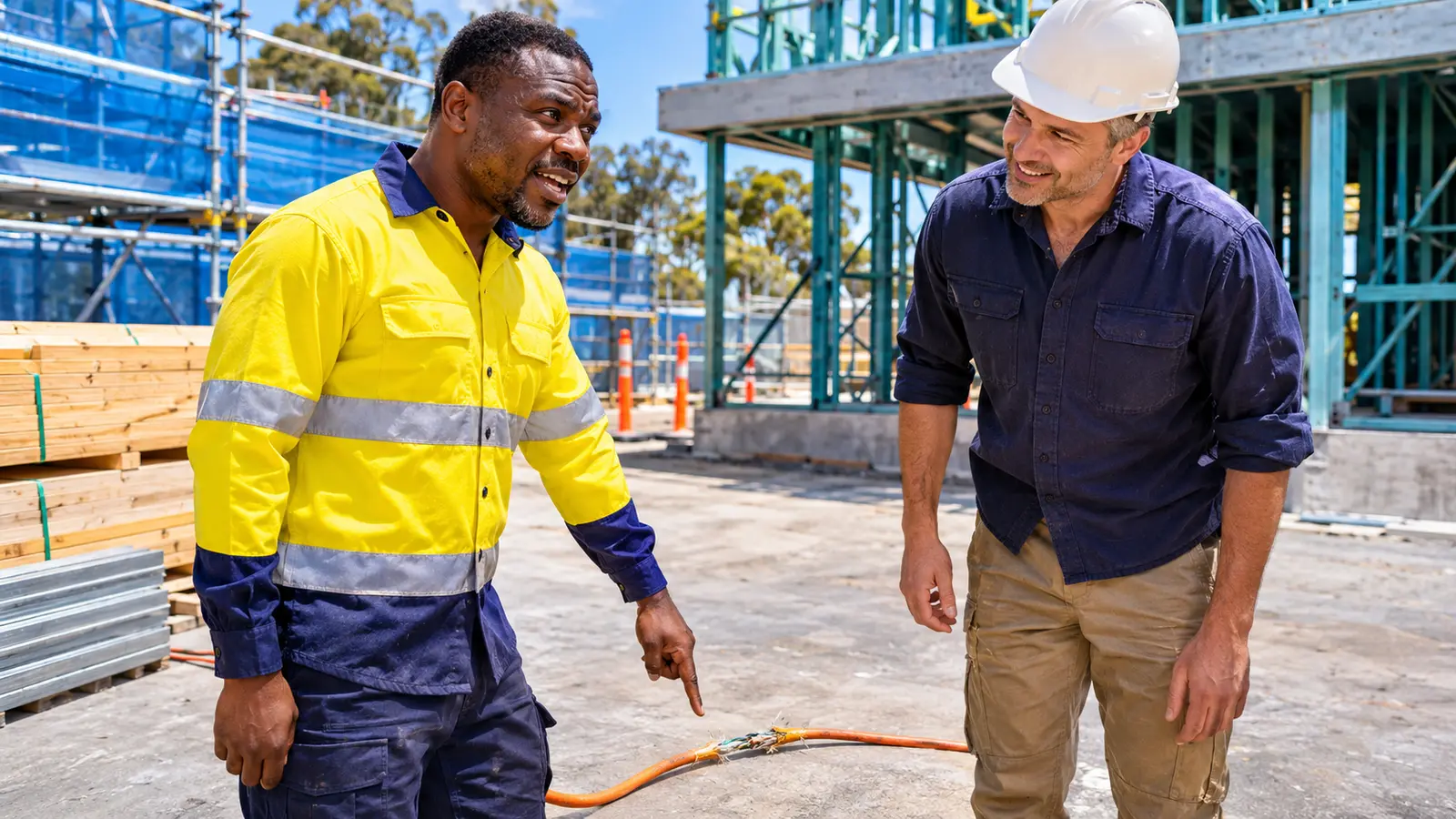
To report a hazard at work, say three things: what you saw, where it is, and what you did about it. Then tell your supervisor or the person in charge straight away. This works in any trade and in any country, and it is the best way to speak up safely when you are the new person and your English is still growing.
Many tradespeople stay quiet in the first weeks because they do not want to look difficult. A short, calm report does the opposite. It shows you can work safely, which is exactly what employers and assessors want to hear. Our guide to workplace safety interview questions shows how the same thinking comes up before you are hired.
What is a hazard, and what is a risk?
Safe Work Australia's glossary defines a hazard as a situation or thing that has the potential to harm a person. Risk is different: it is the possibility that harm (death, injury or illness) might occur when someone is exposed to a hazard. In New Zealand, WorkSafe says a hazard is anything that can cause harm.
A wet floor, a frayed power lead, a missing guard on a grinder, a stack of timber leaning over and a chemical drum with no label are all hazards. The hazard is the thing. The risk is what could happen to you or a workmate because of it.
You can read the official wording on the Safe Work Australia glossary.
Why you are allowed, and expected, to speak up
Under the model work health and safety laws, a person conducting a business or undertaking (PCBU, which includes an employer) has a primary duty to ensure the health and safety of workers while they are at work. Workers have duties too. Safe Work Australia says that while at work, workers must take reasonable care for their own health and safety and that of others who may be affected by their acts or omissions.
In plain words: your employer must keep the workplace safe, and you must take care and not ignore danger. A report is how the two sides connect. Safe Work Australia also says a PCBU must consult with workers who are directly affected by a health and safety matter and take their views into account.
The same idea appears in other countries. The UK Health and Safety Executive says construction workers must report any risks they find to whoever controls the work on site. If you are a plumber, electrician or labourer heading to the UK, this is part of the job from day one. The page is on the HSE site for construction workers.
The three-sentence hazard report
Keep it short. A supervisor on a busy site needs facts, not a long story. Use this order:
- What: name the hazard in simple words. "The extension lead near the wash bay has a cut in the cable."
- Where: say the exact place. "It is on the floor next to bay two."
- What you did: say how you made it safe for now. "I unplugged it and put a cone beside it. Can you tell me who should fix it?"
If you do not know the English word, point and describe. "The thing that holds the blade" is better than silence. You can learn the correct word afterwards from a workmate or from our guide to Australian trade words.
Who to tell
Start with the person who gives you your work. If that person is not there, go one step up. Safe Work Australia also notes that a worker may ask for a Health and Safety Representative (HSR) to represent them on work health and safety matters, so on a larger site an HSR may be another person to talk to.
| Situation | Who to tell first | Simple words to use |
|---|---|---|
| You see a hazard on your own job | Your supervisor or leading hand | "I found a problem with this tool. It is not safe to use. I have tagged it." |
| Your supervisor is away | The next manager, or the site contact | "My supervisor is not here. I need to report a safety problem." |
| The hazard belongs to another crew | Your supervisor, who tells the other crew | "The other crew left a trench open. Please tell them." |
| You are unsure it is a real hazard | Your supervisor, as a question | "Is this safe? I am new and I want to check." |
| Someone is in danger now | Anyone nearby, loudly, and then your supervisor | "Stop. Danger. Please stop work." |
Using the toolbox talk to raise a problem
Safe Work Australia's model Code of Practice for construction work says toolbox talks or pre-start meetings can be used by the builder and subcontractors to give information to workers and receive feedback from them. It says it is best practice to keep a record of the topic covered, attendees and any feedback received.
That makes the morning meeting a good place to speak up. If you are not sure what the meeting is, read our guide to the toolbox talk meaning first. A short line works: "Yesterday I noticed the ladder had a loose rung. Is it fixed?"
When the danger is serious
Sometimes a report is not enough because the danger is happening now. Safe Work Australia says that in some circumstances a worker has a right to stop or refuse to carry out unsafe work if they have a reasonable concern of a serious risk to their health and safety. They must inform the PCBU as soon as they can that they have ceased work and be available to carry out suitable alternative work.
In New Zealand, WorkSafe says a worker has the right to stop work or refuse to carry out work if they believe that doing it would expose them, or anyone else, to a serious risk to health or safety from an immediate or upcoming hazard, and must let the PCBU know as soon as they can.
These are serious steps with conditions. Read the official page on what to do if work becomes unsafe and ask your supervisor or HSR if you are unsure how it applies to your job.
What happens after you report
Employers follow a process to deal with hazards. Safe Work Australia describes the steps for managing risks as identify hazards, assess risks, control risks and review control measures. Your report is the first step, because you have helped identify the hazard.
The best fix removes the hazard completely. Safe Work Australia says eliminating the risk is the best control, and that if this is not possible the risk must be minimised so far as is reasonably practicable. So do not be surprised if your supervisor fixes the cause instead of just handing you gloves.
Ask a follow-up question a day later: "Was the lead replaced?" It shows you care and helps you learn how the workplace handles safety.
Common mistakes
- Saying nothing because your English is weak. A few plain words and a pointing finger are enough.
- Telling a workmate but not the supervisor. A hazard only gets fixed when the person in charge knows.
- Giving a long story. Use what, where and what you did.
- Fixing a hazard you are not trained for. Make the area safe, keep people away and report it. Do not repair electrical or gas faults yourself.
- Saying sorry for reporting. You are doing your job. Say "I want to report a safety problem", not "sorry to bother you".
- Not reporting a near miss. Something that almost hurt someone is still worth a short report.
Practise the words out loud
Reading a report is easy. Saying it quickly, with a busy site around you, is harder. InterviewTraining.ai has a Living & Working Here practice section for workplace culture and Real-Life Scenarios for "what would you do if" questions. You watch an interviewer ask a question on video, answer out loud and get a score from 0 to 10 with a stronger answer. The marking does not take marks off for your accent, small grammar mistakes or simple words.
InterviewTraining.ai is practice only and is not linked to any government, visa authority, skills-assessment body or employer. If you also need to build your English for a test, PractiseNow offers IELTS and PTE practice. You can also read our first week at a new job tips, and the Australia country page for the wider picture.
Rules and requirements can change. Check the official government website before you act.
Frequently asked questions
Do I have to report a hazard, or is it only my supervisor's job?
Safe Work Australia says workers must take reasonable care for their own health and safety and that of others. Telling the person in charge about a hazard is a simple way to do that, even when you did not cause the problem.
What if I report a hazard in the wrong way?
There is no perfect script. A supervisor wants to know what the hazard is and where it is. If you say those two things in simple words, you have done the main job, and you can add the rest when asked.
Can I report a hazard in writing?
Many workplaces have a form or an app for this, and some ask for a written report after a verbal one. Ask your supervisor in your first week how the workplace records hazards, and use the same method every time.
What if my supervisor does not act on my report?
Go one step higher, or ask whether the site has a Health and Safety Representative. Safe Work Australia says a worker may ask for an HSR to represent them on work health and safety matters. Keep the facts short and say when you raised the problem.
Is a near miss worth reporting?
Yes. A near miss shows a hazard is still there, even though nobody was hurt this time. Reporting it gives the employer a chance to control the risk before someone is injured.
Could a hazard question come up in a job interview?
Often, yes. Employers like to ask what you would do if you saw an unsafe situation. Use the same three parts, what, where and what you did, and finish with who you would tell.
Key takeaways
- A hazard is a situation or thing that could harm a person; risk is the chance that harm happens.
- Report in three parts: what you saw, where it is, and what you did.
- Tell your supervisor first, then the next manager or an HSR if needed.
- Use toolbox talks to raise smaller concerns and ask follow-up questions.
- For serious danger, the official pages explain the right to stop unsafe work and who to tell.
Topics
- how to report a hazard at work
- hazard report example
- workplace safety
- speaking up at work
- new job safety
- tradesperson english
- australia workplace