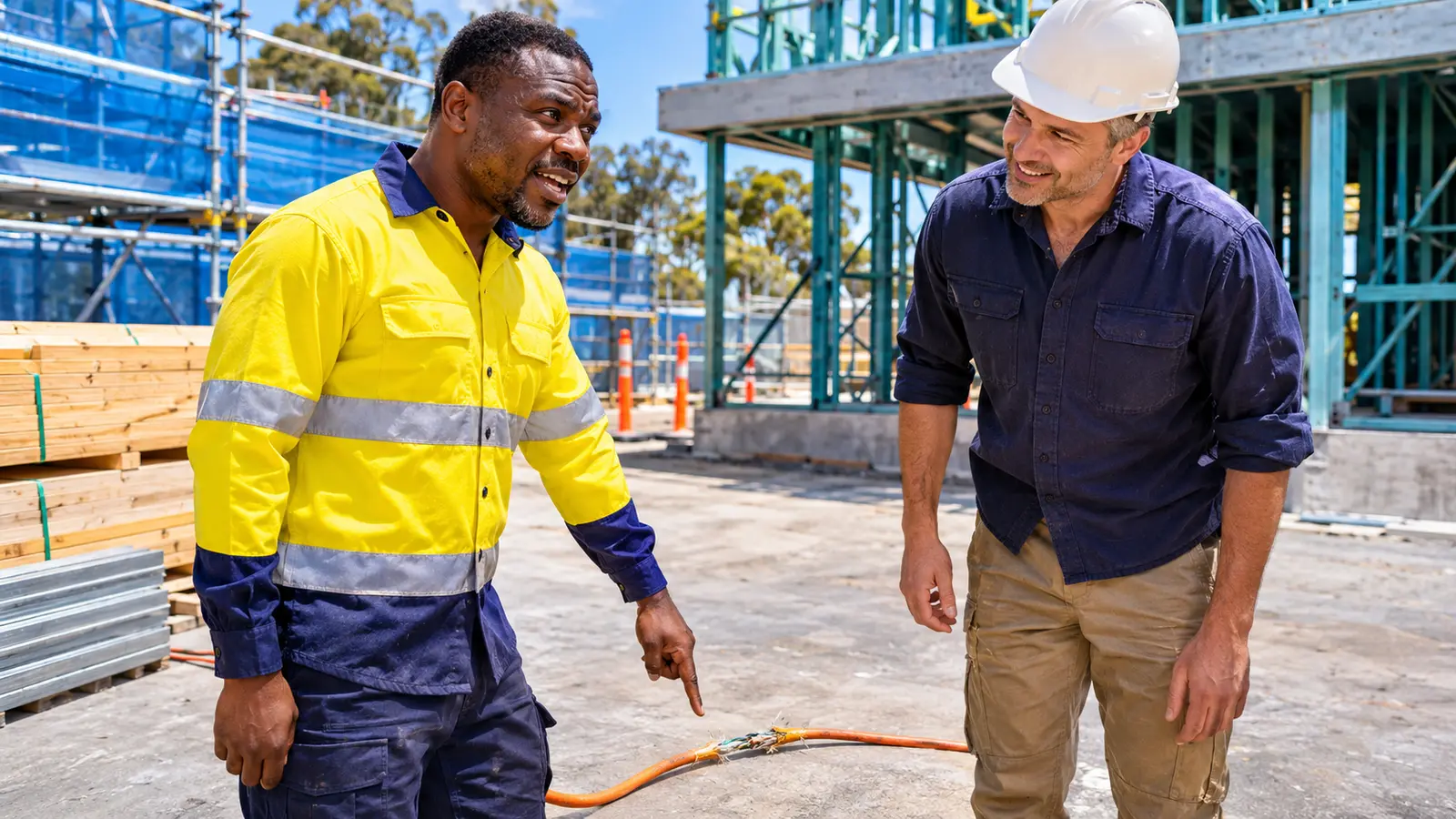
Small talk at work examples are easy to learn: ask about the weekend, the job, the weather or food, listen to the answer and ask one more question. In your first week on a trade site, a few friendly words at smoko (the short morning or afternoon break) matter almost as much as your skills. This guide gives you simple lines to say, questions to ask back, a polite way to end a chat and the topics to leave for later.
Why small talk at smoko matters in your first weeks
Smoko is an everyday word, not an official term. It means the short break when the crew sits down with a cup of tea or coffee. Nobody is testing you there. But your new workmates are learning what kind of person you are, and the way you talk at smoko tells them if you are easy to work with.
Small talk also helps your work. People who feel comfortable with you are more likely to explain how the site runs, show you where things are kept and tell you about a mistake before it becomes a problem. Our post on your first week at a new job covers what to say, ask and write down on a trade site, and this post goes deeper into the break-time talk.
If English is your second language, small talk can feel harder than the interview. The good news is that it is short, it repeats the same patterns and you can practise it. You do not need clever sentences. You need a few safe questions and a friendly face.
Safe topics for small talk with new workmates
Choose topics that anyone can answer without feeling judged. The table shows five safe starting points, a simple line for each and a question to ask back.
| Topic | A simple line to say | A question to ask back |
|---|---|---|
| The weekend | "Did you do anything good on the weekend?" | "Do you do that often?" |
| The job today | "This is a big job. How long have you been on this site?" | "What is the hardest part of it?" |
| Food | "That looks good. Did you make it yourself?" | "What food do you like from your area?" |
| Weather | "It is hot today. Is it always like this?" | "What is the best time of year here?" |
| Sport and hobbies | "Do you follow any sport?" | "Which team should I know about?" |
Notice that every line ends in a question. People enjoy talking about themselves, and a question gives you time to listen. If the other person asks you the same question, a short honest answer is enough: one sentence about your weekend, your home town or a tool you like using.
How to answer when workmates ask about you
New workmates are curious. They will probably ask where you are from, why you came and what you did in your last job. Prepare a short answer for each one, in plain words, and say it slowly.
- Where are you from? "I am from Cebu. I was a welder there for many years."
- What did you do before? "I worked in a workshop that built steel frames. This work is a little different, so I am learning."
- How are you finding it here? "Good, thank you. Everyone has been helpful. The language is new for me, so please tell me if I say something wrong."
These are examples, so change them to fit your own life. If you want help saying who you are in a short, clear way, a short self-introduction video tool can help you practise the words before you meet the crew. The answer for a job interview is similar, and our guide to "Tell me about yourself" for tradespeople shows how to build it.
Understanding Australian smoko words and jokes
Workmates may use everyday words you have not heard: tradie for a tradesperson, sparky for an electrician, chippy for a carpenter, ute for a pick-up truck, arvo for the afternoon, and knock off for finishing work for the day. These are friendly words, not official terms, and you do not need to copy them. You only need to understand them.
Many jokes on site are light teasing. It is normal to laugh with the group, and it is also normal to say, "Sorry, I did not get that. Can you say it again?" Our guide to Australian trade words that confuse new arrivals and the post on Australian and American trade words help with the rest.
The same habit works at the start of the day. In a toolbox talk or pre-start meeting (a short site meeting before work begins), the model Code of Practice for construction work says information is given to workers and feedback is received from them. Speaking up there, even with one question, is a form of small talk too: it shows you are part of the team.
How to start, keep going and leave a conversation: 5 steps
- Say hello and use their name. "Morning, Sam." If you forget a name, say, "Sorry, tell me your name again."
- Ask one easy question. Pick a topic from the table above and keep it open: "How was your weekend?"
- Listen, then ask a follow-up. If someone says they went fishing, ask, "What do you catch?" This is the part that makes small talk easy.
- Share one short answer. One or two sentences about you is enough. You do not need a story.
- Leave politely. "Good talking to you. I am going to check my tools before we start again." Then smile and go.
If the silence feels long, that is fine. Many workers eat and look at their phone at smoko. You do not need to fill every minute, and being quiet is not rude.
Topics to avoid in the first weeks
You do not need to be afraid of every topic, but some are better left until you know the person. Money, age, religion, politics and family are personal, and a question about them can make a new workmate uncomfortable. Complaining about the boss or about another worker is also risky: you do not know who is friends with whom.
There is a legal side as well. The Fair Work Act lists protected attributes that include race, sex, age, religion, family or carer's responsibilities and disability. Jokes or questions about these can hurt people. Visa holders and migrant workers have the same workplace rights and protections as all other employees in Australia, which includes protection from discrimination, so if something said to you crosses a line, you can ask the Fair Work Ombudsman for help.
Culture matters too. The Australian Human Rights Commission gives a useful reminder about interviews: a person who does not shake hands may be showing the appropriate respect within their culture. Workmates from many countries share a crew. If someone does not join a chat, it is not always rude, so give people room.
Common mistakes with small talk at work
- Saying nothing at all. Workmates may think you are unfriendly or unhappy. A greeting and one question each day is enough.
- Asking about pay in the first week. Ask your supervisor in private if you have a real question about your contract or award.
- Pretending to understand. A wrong answer to a joke or an instruction causes more problems than a polite question.
- Talking only about home. Mention your home town, then ask about their area too, so the chat goes both ways.
- Speaking too fast when nervous. Slow down. A clear sentence is better than a quick one nobody catches.
Practise small talk out loud before day one
Small talk gets easier when your mouth already knows the words. Say your three short answers aloud, ask the five questions from the table and practise leaving a chat politely. The practice section Living and Working Here helps you get used to workplace culture, and General Practice lets you rehearse the personal questions an employer may ask. On InterviewTraining.ai you answer out loud and the marking does not take marks off for your accent, small grammar mistakes or simple words. It is practice only, and it works on a phone or a laptop.
The customs differ a little by country. Our pages for Australia and New Zealand explain what to expect in each place. If you worry about your English, the post on English level in a trade interview shows that clear and simple is enough.
Rules and requirements can change. Check the official government website before you act.
Frequently asked questions
What is smoko?
Smoko is an everyday Australian word for the short morning or afternoon break at work. It is not an official term, and most people who say it do not smoke. You will hear it on building sites, in workshops and on farms.
Do I have to talk at smoko?
No, but a few friendly words help new workmates get to know you. You can sit with the group, listen, smile and answer when someone asks you something. Short answers are fine, and you can always say you need to make a call.
What if I do not understand a joke or a slang word?
Smile and ask, "Sorry, what does that mean?" Most workmates enjoy explaining it. Asking shows that you are interested, and it is better than pretending you understood and answering the wrong thing.
Can I ask workmates about their pay or their age?
It is safer to wait. Questions about money, age, family or religion can feel personal in the first weeks, and they can make some people uncomfortable. Let workmates bring those topics up first, and ask about the work, the weekend or food instead.
What if my English is not strong enough for small talk?
Small talk uses simple words, and workmates do not mark your grammar. Prepare four or five short questions and say them slowly. If you miss something, ask the person to say it again.
Key takeaways
- Small talk is short: ask an easy question, listen, ask one more, then share one sentence about you.
- Safe topics are the weekend, the job, food, weather and hobbies.
- Prepare simple answers about where you are from and what you did before.
- Leave money, age, religion, politics and complaints for later.
- If you do not understand a word or a joke, ask politely. It shows interest.
- Practise the lines out loud before your first day.
Topics
- small talk at work examples
- small talk topics at work
- australian small talk
- smoko meaning
- first week at work
- tradie jobs australia
- new workmates
- new zealand workplace