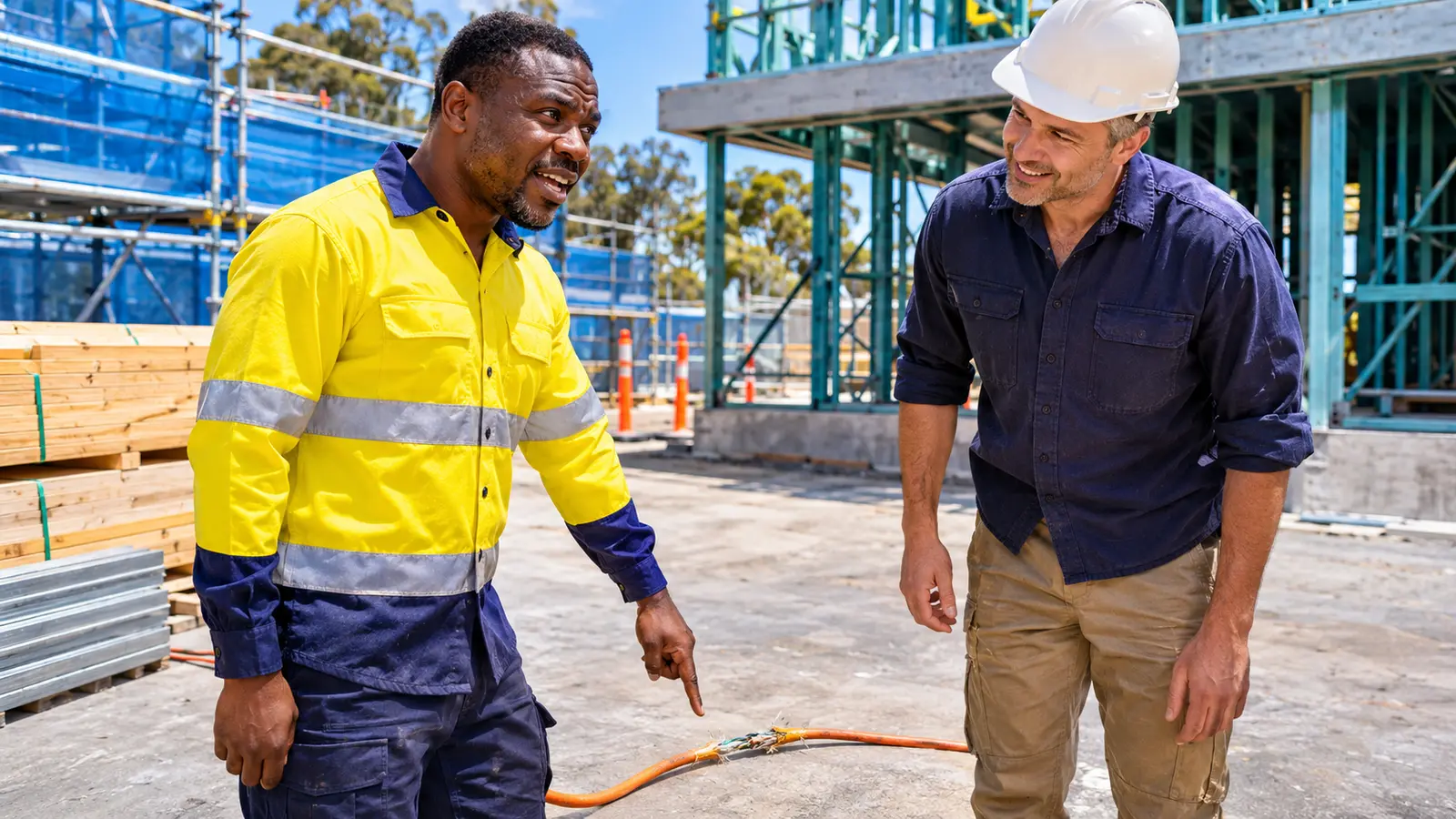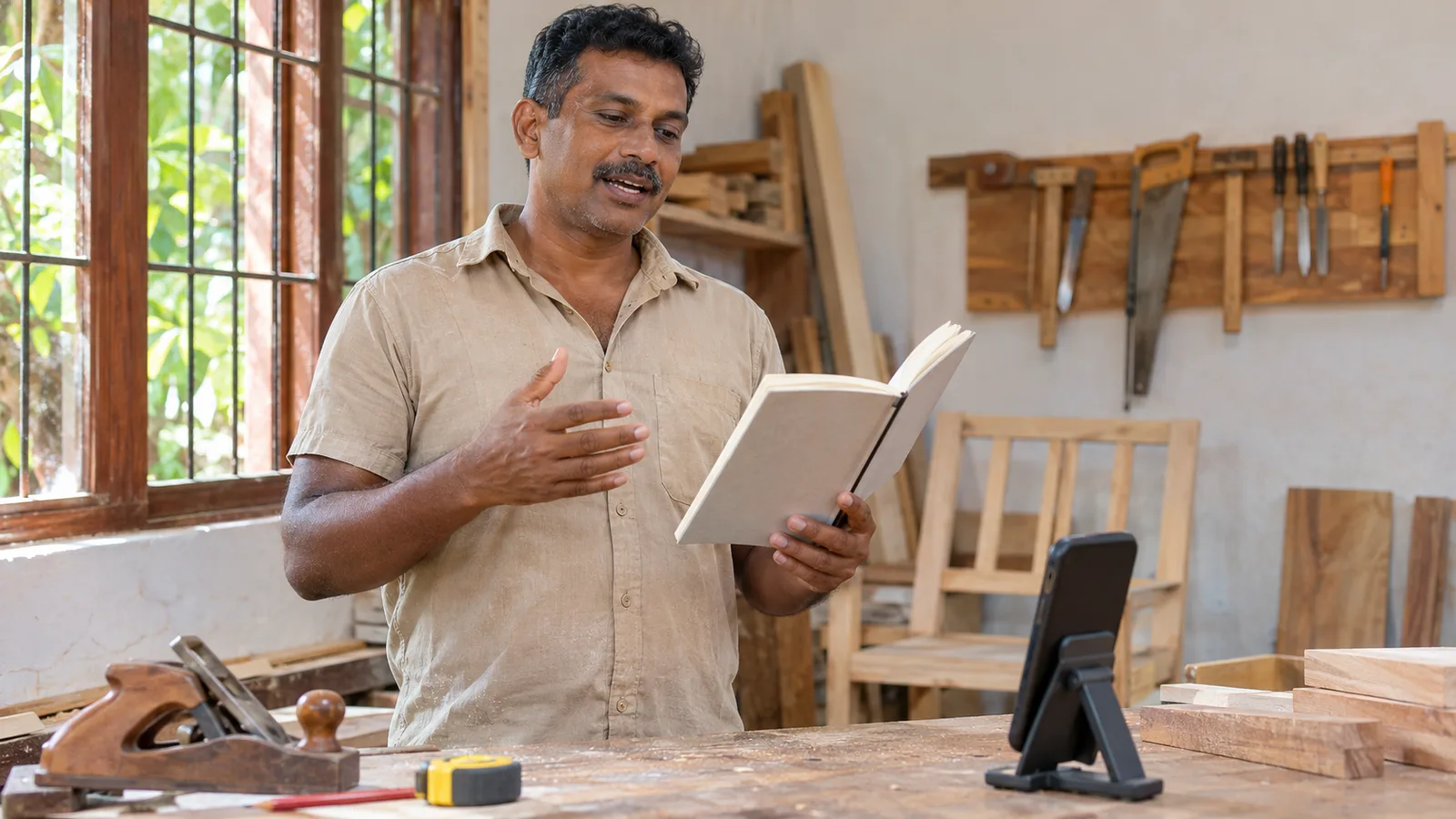
A toolbox talk is a short safety meeting at the start of a shift or a job. The crew stands together while a supervisor goes through today's tasks, the hazards and how they are controlled. Many Australian sites call it a pre-start. Your part is simple: listen, ask when something is unclear, report any risk you have seen, then sign the attendance sheet.
What a toolbox talk is, in plain English
The name comes from a quick chat around the toolbox before the tools come out. It is not a class and nobody is testing you. On a building site, in a workshop or in a commercial kitchen, the idea is the same: a few minutes to agree how today's work will be done safely.
Safe Work Australia's model Code of Practice: Construction work describes toolbox talks or pre-start meetings as a way for the builder and subcontractors to give information to workers and to receive feedback from them. Look at the second half of that sentence. The meeting is meant to work in both directions.
That fits the law. Under the model work health and safety (WHS) laws, the business you work for is called a PCBU: a person conducting a business or undertaking. A PCBU must consult workers who are directly affected by a health and safety matter, take their views into account and tell them the outcome. You have duties too: take reasonable care of yourself and others, and follow reasonable safety instructions. Safe Work Australia lists them on its page about duties under WHS laws.
What happens in a typical toolbox talk
Every site runs its talk its own way, but most follow a similar shape. When you know the shape, the English is easier to follow, because you can guess what comes next.
| Part of the talk | What you might hear | What you do |
|---|---|---|
| Today's work | "We're pouring the slab on level two this morning." | Listen for your own task and where it is. |
| Hazards | "The crane starts lifting at nine, so keep out of the exclusion zone." | Note the place, the time and the danger. |
| Controls | "The barriers are up and the spotter will call each lift." | Check who is in charge of each control. |
| PPE | "Hard hat, glasses and hi-vis on the deck at all times." | Check your own gear before you walk out. |
| Questions and feedback | "Anything from anyone?" | Ask your question or report a hazard. |
| Sign-on | "Sign the sheet before you head off." | Print your name clearly, then sign. |
Words you will hear at a pre-start
Safety English is full of short forms. Learn what the letters stand for, so you can say the full words if a supervisor or an interviewer asks.
| Word | Meaning | A sentence you can use |
|---|---|---|
| PPE | Personal protective equipment: anything you wear or use to keep yourself safe | "My PPE for this job is gloves, glasses and ear muffs." |
| Hi-vis | High visibility clothing (an everyday word) | "I'll grab my hi-vis from the ute." |
| SWMS | Safe Work Method Statement: a written document for high risk construction work | "Can I read the SWMS for the roof work first?" |
| Hazard | A situation or thing that has the potential to harm a person | "There's a hazard on the stairs: two loose boards." |
| Control measure | An action taken to remove or reduce a health and safety risk | "What's the control for working near the trench?" |
| HSR | Health and safety representative: a worker elected by a work group to speak for them on safety | "Who's the HSR for our crew?" |
A SWMS is needed for high risk construction work, for example where a person could fall more than 2 metres, or near a trench deeper than 1.5 metres. The code says it must be readily accessible to the workers doing that work. If the supervisor mentions a SWMS you have not seen, say so before you pick up a tool.
How to ask a question in front of the group
For many second-language speakers this is the hardest part. Everyone wants to start, and your English feels slower than usual. But one short question now can prevent an injury later.
- Wait for the gap. Let the supervisor finish a topic or ask "Any questions?".
- Get attention politely. Lift your hand a little: "Sorry, one quick question."
- Say what you heard. "You said the crane starts at nine."
- Ask one clear thing. "Should my crew stop work on the west side during the lifts?"
- Repeat the answer back. "Okay, so we move to the east wall until the lifts finish. Thanks."
If you missed a word, say: "Sorry, I didn't catch that. Could you say it again?" Noise and fast speech confuse local workers too. If you are not ready to speak in front of everyone, find the supervisor straight after the talk, before work starts.
Reporting a hazard you have seen
The feedback part is the right time to report something you noticed. Say what it is, where it is, and what you have done so far.
- "The guard rail on the north side of level one is loose. I've taped it off, but it needs fixing."
- "There's oil under hoist three. Can we get the spill kit before anyone works there?"
In some situations a worker has a right to stop or refuse unsafe work, if they have a reasonable concern about a serious risk to their health and safety. They must tell the business as soon as they can and be available for other suitable work. Safe Work Australia explains this on its page about what to do if work becomes unsafe.
Signing the toolbox talk sheet
At the end you will usually sign a paper sheet or tap your name on a tablet. The construction code says it is best practice to keep a record of the topic covered, the people who attended and any feedback received. Your signature is part of that record: it shows you were one of the attendees.
So read what the sheet says about the topic before you sign. If you arrived late or missed a part, tell the supervisor first, so they can go over it with you.
- Sign only for yourself, never for a mate who is running late.
- Sign only for a talk you were at.
- If a key point was unclear, ask first, then sign.
How toolbox talks come up in a job interview
Employers want to know you will join the safety routine from your first morning. Safety also comes first in skills assessments: VETASSESS's list of technical interview areas for trades such as carpenter, bricklayer and motor mechanic starts with workplace health and safety, including spotting hazards on the worksite and wearing the correct PPE.
| Question | What the interviewer wants | A simple answer could be |
|---|---|---|
| "Have you done toolbox talks before?" | That you know the routine and take part | "Yes, every morning at my last job. I listened, asked when I was unsure, and signed the sheet." |
| "Tell me about a time you raised a safety problem." | A real, short example with an outcome | "At a pre-start I said a ladder had a cracked foot. The supervisor took it out of use." |
| "What would you do if you missed the morning talk?" | That you would not just start work | "I would find the supervisor, ask what was covered, and sign once they had explained it." |
Give the answer first, add one example from your own work, then stop. Our guide to workplace safety questions in an overseas trade interview has more like these, and real-life scenario questions shows how to handle "what would you do" questions.
Toolbox talks in New Zealand, the UK and Canada
New Zealand. WorkSafe says a business must ask for workers' input on their health and safety, and it is an offence to engage in adverse conduct against a worker because they raised a safety concern. Read WorkSafe's page on workers' rights and obligations.
United Kingdom. The Health and Safety Executive (HSE) says employers have a duty to consult workers, or their representatives, on health and safety. Construction workers must report any risks they find to whoever controls the work on site.
Canada. The Canadian Centre for Occupational Health and Safety lists three basic worker rights: to know about health and safety matters, to take part in decisions that affect them, and to refuse unsafe work.
For Australia, see our Australia interview practice page.
Common mistakes at toolbox talks
- Nodding when you did not understand. A nod tells the supervisor you know the plan. If you do not, ask.
- Keeping quiet because you are new. New eyes often see what others stopped noticing.
- Signing for a talk you missed, or for someone else. The sheet is a record of who was there.
- Trying to fit in with slang. You will hear smoko and arvo. Clear, plain English is better.
- Treating PPE as the whole answer. The code calls PPE the lowest order control measure, because it does nothing to change the hazard itself.
Practise the toolbox talk English before your first day
Speaking up in front of strangers gets easier once you have said the sentences out loud a few times. The Picture Quiz helps with tool names, trade words and safety signs. Then try Real-Life Scenarios and Living & Working Here. You answer out loud and get a score from 0 to 10, with what you did well, what to add and a stronger answer. Your accent does not lose marks.
Our list of Australian trade words that confuse new arrivals explains more site words, and the first week at a new job tips cover the induction and your first days.
When you apply, list your white card and other safety training clearly as you build your CV, then search for trade roles on Talynx.
Rules and requirements can change. Check the official government website before you act.
Frequently asked questions
What is the meaning of toolbox talk?
A toolbox talk is a short safety meeting at the start of a shift or a job. Safe Work Australia's construction code describes toolbox talks or pre-start meetings as a way to give workers information and to receive feedback from them, so you are expected to listen and to speak.
Is a pre-start meeting the same as a toolbox talk?
The construction code puts the two names side by side, and on most sites they mean the same short meeting before work. If your site uses both names for different meetings, ask your supervisor what each one covers.
Do I need to sign the toolbox talk sheet?
Most sites will ask you to, because the code says it is best practice to record the topic, who attended and any feedback. Sign only for yourself and only for a talk you were at. If a key point was unclear, ask first, then sign.
What if I cannot follow the English in the talk?
Stand close to the speaker and ask them to repeat any word you missed. If you still have a doubt, see the supervisor straight after the talk. The business must give the information, instruction and training needed for safe work, so asking is normal.
Key takeaways
- A toolbox talk, or pre-start, is a short safety meeting before work, meant to go both ways.
- Learn the short forms PPE, SWMS and HSR, and the words hazard and control measure.
- To ask a question: wait for the gap, say what you heard, ask one thing, repeat the answer.
- Sign the sheet only for yourself and only for a talk you attended and understood.
- Have a short, true toolbox talk example ready for your job interview.
Topics
- toolbox talk
- pre-start meeting
- workplace safety
- english for work
- australia
- trade jobs