In Australia, the hand tool that turns nuts and bolts is called a spanner. If you say "wrench", people will understand you, but Australians keep that word for only a few tools, such as the torque wrench and the pipe wrench. So "spanner vs wrench" is not a choice between two tools. It depends on which English you learned. This guide lists the tool names you will hear in an Australian workshop. It also gives you one clear sentence for each name, ready for your interview.
What is the difference between a spanner and a wrench?
Most of the time the tool is the same and only the country is different. American English uses "wrench" for almost every tool that turns a nut, a bolt or a pipe. Australian English follows British English here. A tool with a fixed opening for one size of nut is a spanner.
Tool names are only one part of the picture: see the wider list of Australian vs American English words across automotive, electrical, plumbing, building and kitchen trades in our guide to Australian vs American English for tradespeople.
Australians still use "wrench" in a small group of names. A torque wrench, a pipe wrench and an impact wrench all keep the word.
Australian tool names, with a sentence to say for each one
The table shows the name used in Australian workshops, the name you may have learned, and a short sentence you can change to suit your own work.
| Australian name | You may know it as | A sentence you can say |
|---|---|---|
| Open-ended spanner | Open-end wrench | "I use an open-ended spanner where a ring spanner cannot get onto the nut." |
| Ring spanner | Box-end wrench | "For a tight bolt I pick a ring spanner, because it holds the whole head." |
| Shifter (adjustable spanner) | Adjustable wrench | "I keep a shifter for odd sizes, but I do not put it on a tight nut." |
| Socket and ratchet | Socket wrench | "I fit a 10 mm socket to the ratchet and remove the cover bolts." |
| Allen key | Allen wrench or hex key | "I loosen the small locking screw with an Allen key, then the pulley slides off." |
| Stillson (pipe wrench) | Pipe wrench | "One Stillson holds the steel pipe while I turn the fitting with another." |
| Torque wrench | Torque wrench | "I finish the wheel nuts with a torque wrench set to the maker's figure." |
| Rattle gun (impact wrench) | Impact wrench or impact gun | "The rattle gun takes the wheel nuts off quickly, but I never use it for final tightening." |
"Rattle gun" is informal, and "impact wrench" is always correct. "Socket wrench" is rare in Australia. People name the two parts instead: the socket, and the ratchet that drives it.
Shifter, Stillson and Allen key: three names to learn first
Shifter
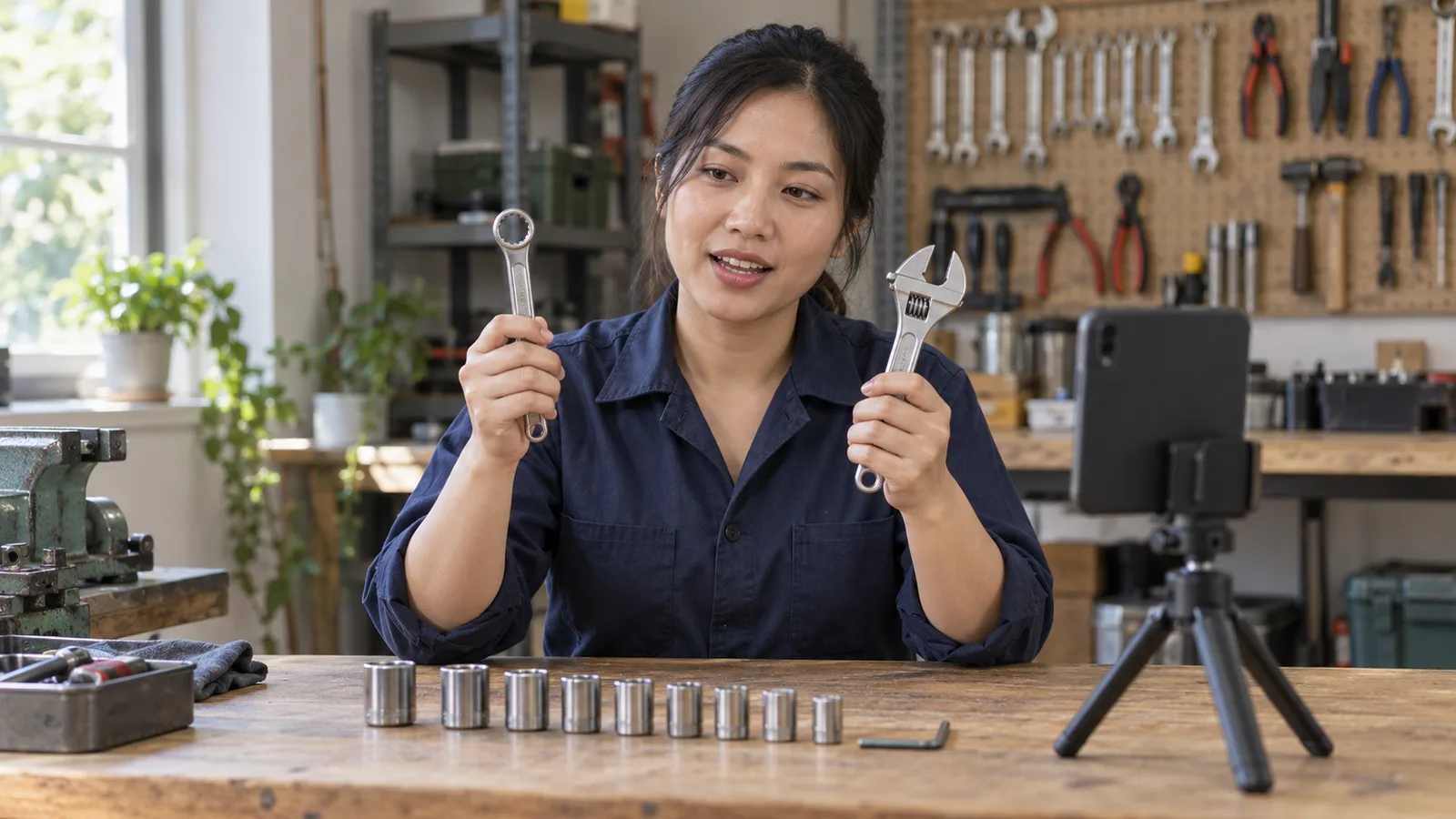
A shifter is an adjustable spanner. One jaw moves when you turn a small wheel with your thumb, so one tool fits many sizes. "Shifter" is informal. The full names are "shifting spanner" and "adjustable spanner".
In an interview, show that you know its limit. A shifter can slip and round off the corners of a nut. A simple answer could be: "I carry a shifter, but on a tight or damaged nut I use a ring spanner of the correct size."
Stillson
A Stillson is a heavy pipe wrench with teeth in its jaws. The jaws bite harder as you pull the handle, so the tool grips round pipe. Plumbers and fitters often say "Stillsons", even for one tool. "Pipe wrench" is also correct.
The teeth leave marks, so a good answer says where you would not use it. For example: "I keep Stillsons away from chrome and soft brass, because the teeth damage the surface."
Allen key
An Allen key is a small L-shaped bar with six flat sides. It fits a screw that has a six-sided hole in its head. You may have learned "Allen wrench" or "hex key". In Australia "Allen key" is the everyday name.
Why tool names matter in a trade interview
Tool questions are a normal part of a technical interview. VETASSESS is a skills assessment authority for trade occupations. Its list of technical interview areas for a motor mechanic includes selecting appropriate tools and equipment. One practice question it suggests is "Explain how a tool/piece of equipment you use works".
The person asking comes from your trade. VETASSESS says its assessor is a qualified tradesperson with many years of experience working in Australia in that occupation. Someone with that background is likely to say "spanner" and "shifter" as a habit.
In a face-to-face technical interview, VETASSESS says the room may be a simulated workplace containing tools and equipment. Be ready to name what is on the bench, not just point at it.
The technical interview is conducted in English, and no interpreter is allowed. VETASSESS also tells candidates to ask the assessor to repeat a question they do not understand. So asking about a word is normal. Our guide to a motor mechanic's skills interview for Australia explains the day in more detail.
Employers check tool knowledge too. The Fair Work Ombudsman gives an example of an unpaid work trial at a panel beaters. After the interview, the applicant follows a tradesman doing body repairs, and the tradesman checks that he knows how to work safely and use the right tools.
How to name a tool in an interview answer
A tool name alone is a thin answer. The interviewer wants to hear why you chose the tool. Use these five steps.
- Say the Australian name. "A ring spanner" is better than "this one".
- Add the size or the type. "A 10 mm ring spanner" shows that you work with care.
- Say the job. "I loosen the battery terminal with it."
- Give your reason. "It holds the whole nut, so it does not slip."
- Add safety or damage where it fits. "I pull the spanner towards me. If it slips, my knuckles do not hit the engine."
Two examples follow. Change the details to match your own work.
Motor mechanic: "Which tools do you use to refit a wheel?"
A simple answer could be: "I start the wheel nuts by hand. Then I bring them up evenly with a socket and ratchet. I finish with a torque wrench set to the maker's figure. I do not finish with the rattle gun, because it can make the nuts too tight."
Fitter: "How do you remove a socket head screw?"
A simple answer could be: "I clean the head first. Then I choose the Allen key that goes fully into the hole. A loose key rounds the hole, and after that the screw is hard to get out."
If the word will not come, describe the tool and ask. You could say: "Sorry, I have forgotten the Australian name. It is the adjustable one with the moving jaw. Is that a shifter?"
More tool names that change between countries
Spanners are not the only tools with two names. These four come up often.
- Multigrips: pliers with a jaw that slides to several widths. American English often says tongue-and-groove pliers.
- Side cutters: small cutting pliers for wire. You may know them as diagonal cutters.
- G-clamp: the screw clamp shaped like the letter G. In American English it is a C-clamp.
- Pinch bar: a steel bar for levering and pulling nails. You may call it a crowbar or a pry bar.
One saying is worth knowing too. "How long have you been on the tools?" asks how long you have done hands-on trade work.
This guide stays with hand tools. For vehicle parts, break times and site words, read our list of Australian trade words that confuse new arrivals.
Common mistakes with tool names
- Stopping when you hear "spanner". Some people freeze because they learned "wrench". Keep going. You already know the tool.
- Saying "shifter" for every job. It can sound as if you do not own the right sizes. Name the fixed spanner first.
- Giving the name and nothing else. Add the job and the reason, as in the five steps above.
- Guessing a word you did not hear clearly. Ask for the question again. A wrong guess wastes your answer.
- Learning the list in silence. You will need these words in speech, so practise them out loud.
Practise the tool names out loud
Choose six tools you use every week. For each one, say the Australian name, the job and your reason. Record yourself on your phone and listen back.
On InterviewTraining.ai you watch an interviewer ask a question on video, and you answer out loud. You then get a score from 0 to 10, with what you did well, what to add, and a stronger answer. The marking does not take marks off for your accent, small grammar mistakes or simple words. A short, clear sentence with the right tool name is enough.
The Picture Quiz is the section for tool names and trade words. For longer answers, such as the wheel example above, use Skills Practice for technical trade questions. See the trades we cover, or start at our Australia interview page.
This is practice only. It is not linked to any government, skills-assessment body or employer, and it does not decide the result of your interview.
Rules and requirements can change. Check the official government website before you act.
Frequently asked questions
Is it spanner or wrench in Australia?
Australians say spanner for the hand tool with a fixed opening that turns nuts and bolts. Wrench is understood, but it is kept for a few tools, such as the torque wrench.
What does shifter mean in an Australian workshop?
A shifter is an adjustable spanner. One jaw moves when you turn a small wheel with your thumb, so the same tool fits many sizes of nut. Shifter is the informal name.
Which tools do Australians still call a wrench?
The most common ones are the torque wrench, the pipe wrench and the impact wrench. A pipe wrench is often called a Stillson, and an impact wrench is often called a rattle gun.
Is it wrong to say wrench in an Australian trade interview?
No. Both words are understood in Australia, so the interviewer can still follow you. It matters more that you name the type and size of tool and give your reason.
What is a Stillson?
A Stillson is a heavy pipe wrench with teeth in its jaws. The jaws grip harder as you pull the handle, so it holds round steel pipe.
Key takeaways
- In Australia a spanner turns nuts and bolts. "Wrench" stays in a few names: torque wrench, pipe wrench and impact wrench.
- A shifter is an adjustable spanner, a Stillson is a pipe wrench, and an Allen key is a hex key.
- Both words are understood, so keep going if "wrench" comes out first.
- In an answer, give the name, the size or type, the job and your reason.
- If you forget a name, describe the tool and ask. If you do not understand a question, ask for it again.
Topics
- spanner vs wrench
- australian tool names
- shifter
- trade english
- interview english
- tool vocabulary