The walk me through interview question asks you to explain one job from start to finish, out loud, in order. A clear answer has five parts: the job, the tools, the steps in order, the safety check and the final test. This guide gives you the pattern, one worked example and the small linking words that keep your answer smooth.
Why interviewers ask you to walk them through a job
When an interviewer says "walk me through how you would replace a set of brake pads" or "talk me through that weld", they are not testing your memory of a manual. They want to hear how you think and work.
They listen for three things. Do you know the right order? Do you think about safety before you start? Do you check your own work at the end? An experienced tradesperson does all three without noticing, so the answer shows your experience quickly.
The five-part pattern for a walk me through answer
Use these five parts every time. You can say each one in one or two short sentences.
| Part | What you say | A simple phrase to start |
|---|---|---|
| 1. The job | Name the task and what the finished job looks like | "The job is to ... so that ..." |
| 2. The tools | Say the main tools and materials you collect first | "First I get ready. I need ..." |
| 3. The steps | Give the main steps in order, with a short reason for each | "Then I ... because ..." |
| 4. The safety check | Say the hazard you look for and how you control it | "Before I start, I check ..." |
| 5. The final test | Say how you know the job is done and correct | "At the end I test it by ..." |
Notice that safety comes before the work in the order you say it, even though it is part four in the table. In a real answer, you can mention the safety check early ("before I start") and again when you test. Interviewers in Australian workshops and sites pay close attention to it.
How to say the safety part in simple words
You do not need to quote a law. A simple safety sentence is enough, and it should match what you really do. Safe Work Australia describes a step-by-step approach to managing risks: identify hazards, assess the risks, control the risks and review the control measures. You can follow the same four ideas in everyday words.
A hazard is a situation or thing that could harm a person. Risk is the chance that harm happens when someone is exposed to the hazard. So in your answer you can say: "I look for the hazard, I decide how serious it is, I control it, and I check again when the job changes."
If you want to read how a safety interview question works in more detail, see our guide to workplace safety interview questions.
A worked example: changing the brake pads on a car
Here is how a motor mechanic could answer. This is an example for you to adapt, not a script to memorise. Use your own trade, tools and way of working.
The question: "Walk me through how you change the front brake pads on a car."
A simple answer could be:
"The job is to replace worn front brake pads so the car stops safely. First I get ready. I need a jack and stands, a wheel brace, a spanner set, a brake piston tool, new pads and brake cleaner.
Before I start, I check that the car is on flat ground with the handbrake on. I put the car on stands, never only on the jack, because the car could fall. I wear gloves and glasses, and I do not blow brake dust with an air gun.
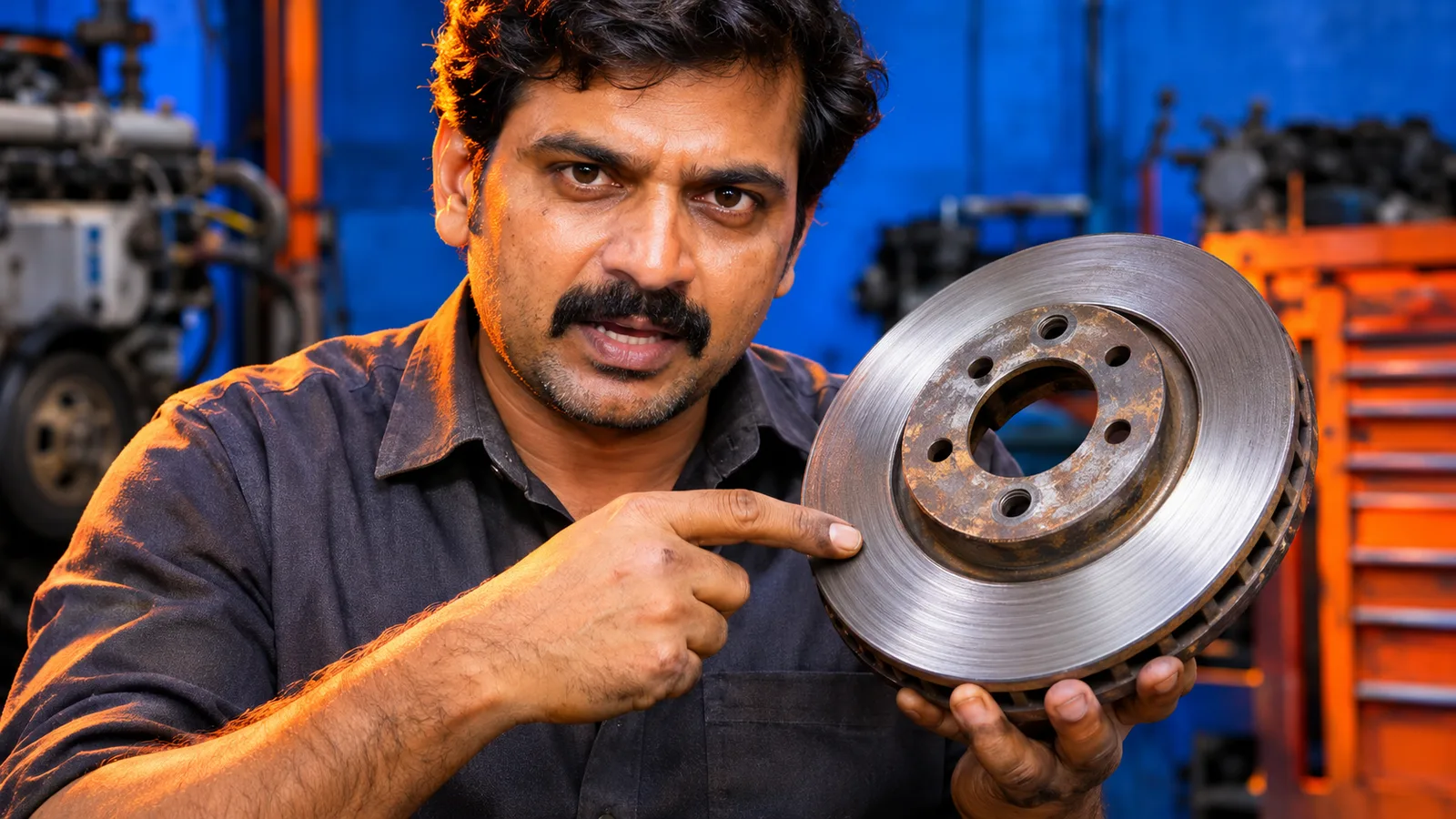
Then I take off the wheel and look at the brake. I remove the caliper bolts, lift the caliper away and hang it so the hose does not carry its weight. I take out the old pads and check the disc for wear and cracks. After that I push the piston back, fit the new pads and put the caliper back. Then I tighten the bolts to the figure in the manual.
At the end I refit the wheel, lower the car and press the brake pedal several times until it feels firm. Then I do a short road test and check the pedal and the stopping again. I also tell the customer if the discs need work."
That answer is short, but it has all five parts. It also gives a reason for the important steps ("because the car could fall", "so the hose does not carry its weight"). The reason is what shows an interviewer that you understand the job and do not only repeat it.
If you are a welder, chef, electrician or carpenter, the shape is the same. Change the job, the tools and the safety check. Our trade guides for the welder and the motor mechanic show the kind of detail each trade usually needs.
The linking words that hold your answer together
Many second-language speakers know the trade steps but sound broken because the sentences do not connect. A few small words fix this. Use them in the same order every time.
| When you want to say | Use words like | Example |
|---|---|---|
| The first step | first, to start with, before I begin | "Before I begin, I isolate the power." |
| The next step | then, next, after that | "After that, I remove the old part." |
| A reason | because, so that, to avoid | "I clamp it so that it does not move." |
| A check | I make sure, I confirm, I test | "I confirm it is tight before I move on." |
| The end | finally, at the end, to finish | "Finally, I clean up and tell the supervisor." |
How to practise your walk me through answer
Practise out loud. Reading your answer in your head does not train your mouth. Follow these steps for each job you might be asked about.
- Pick one task you do often, such as a service, a joint, a rough-in or a standard dish.
- Write the five parts as short notes, not full sentences. Four to six words for each step is enough.
- Say the answer out loud while you look at the notes. Time yourself.
- Put the notes away and say it again. Where you stop is the part to practise.
- Change one detail, such as a different vehicle, material or site, and say it once more.
Do this for three or four core tasks of your trade. You can then adapt them to nearly any "walk me through" question.
Common mistakes in a walk me through answer
- Starting in the middle. If you jump to the repair, the interviewer cannot see how you prepare. Start with the job and the tools.
- Leaving out safety. A technically perfect answer with no safety check can sound careless in Australia, New Zealand, the United Kingdom and Canada.
- Giving a list with no reasons. "I do this, I do this, I do this" sounds like a memory test. Add a short "because".
- Going too fast. Speed makes it harder to understand your accent and your words. Speak slowly and pause after each step.
- Saying "everyone knows this". The interviewer wants to hear the detail. Treat every question as if they cannot see your hands.
- Making up experience. Describe jobs you have really done. If you have not done a task, say what you know and how you would learn it.
Where this question appears
You may meet a walk me through question in a first interview with an employer, in a video interview, or in a technical interview for a skills assessment. In the Trades Recognition Australia process, the assessor who carries out the technical assessment is a qualified assessor who is also a qualified tradesperson in the applicant's Nominated Occupation. For Pathway 2, the assessor checks whether the applicant can undertake the full range of tasks expected of a tradesperson in Australia through a technical interview and evidence from the employer or referee. Read the official page for Pathway 2 of the Offshore Skills Assessment Program to see what applies to you, and read our guide to the skills assessment technical interview.
Practise the answer out loud
Saying the answer aloud with a timer is the fastest way to find the gaps. On InterviewTraining.ai you watch an interviewer ask a question on video, answer out loud, and get a score from 0 to 10 with what you did well, what to add, and a stronger answer. The Skills Practice section has technical trade questions, and the Mock Interview section runs a full interview. The answer timer follows the English level you choose: Foundation gives 90 seconds for each answer, Working gives 75 seconds and Fluent gives 60 seconds. It is practice only and is not linked to any government, visa authority, skills-assessment body or employer. You can see how each part works on the how it works page.
It also helps to write your tasks and experience clearly before the interview. A tool such as Build AI CV can help you list your skills in one place, and a short video introduction from SelfIntroVideo gives you more practice speaking about your work on camera. Browse the trade pages for questions that fit your own job, and read five technical questions to practise in any trade for more examples.
Rules and requirements can change. Check the official government website before you act.
Frequently asked questions
How long should my answer to "walk me through it" be?
Aim for about one to two minutes when you say it out loud. That is long enough to cover the five parts and short enough that the interviewer can ask a follow-up question. If they want more detail on one step, they will ask.
What if I do not remember the English name of a tool or a step?
Describe it in simple words and keep going. For example, say "the tool that tightens the bolt to the right force" and then ask, "Is that the word you use here?" Interviewers value a clear explanation more than a perfect word, and they often give you the name.
Should I describe the job exactly as I did it in my last workshop?
Describe the way you really work, but say why you do each step. If your old workplace used a different method from Australian practice, you can say so honestly and say that you are happy to follow the local procedure. That shows you can learn.
Is it fine to say that I would check the manual or the job sheet?
Yes. Good tradespeople check the manufacturer information or the job sheet instead of guessing. Say it as one step in your process, not as a way to avoid the question.
Can I use the same five parts in a skills assessment technical interview?
Yes, the pattern works for any question where you explain how you do a task. The assessor is a qualified tradesperson in your occupation, so they can follow detail. Always check the official assessment pages for what your own assessment includes.
Key takeaways
- A walk me through answer has five parts: the job, the tools, the steps, the safety check and the final test.
- Give a short reason for each important step with "because" or "so that".
- Use simple linking words: first, then, after that, finally.
- Practise three or four core tasks out loud until you can say them without notes.
- Describe only the work you have really done, and say honestly what you would check or learn.
Topics
- walk me through interview question
- explain a process in an interview
- trade interview questions
- technical interview answer
- tradesperson interview
- skills assessment interview
- interview english for tradespeople