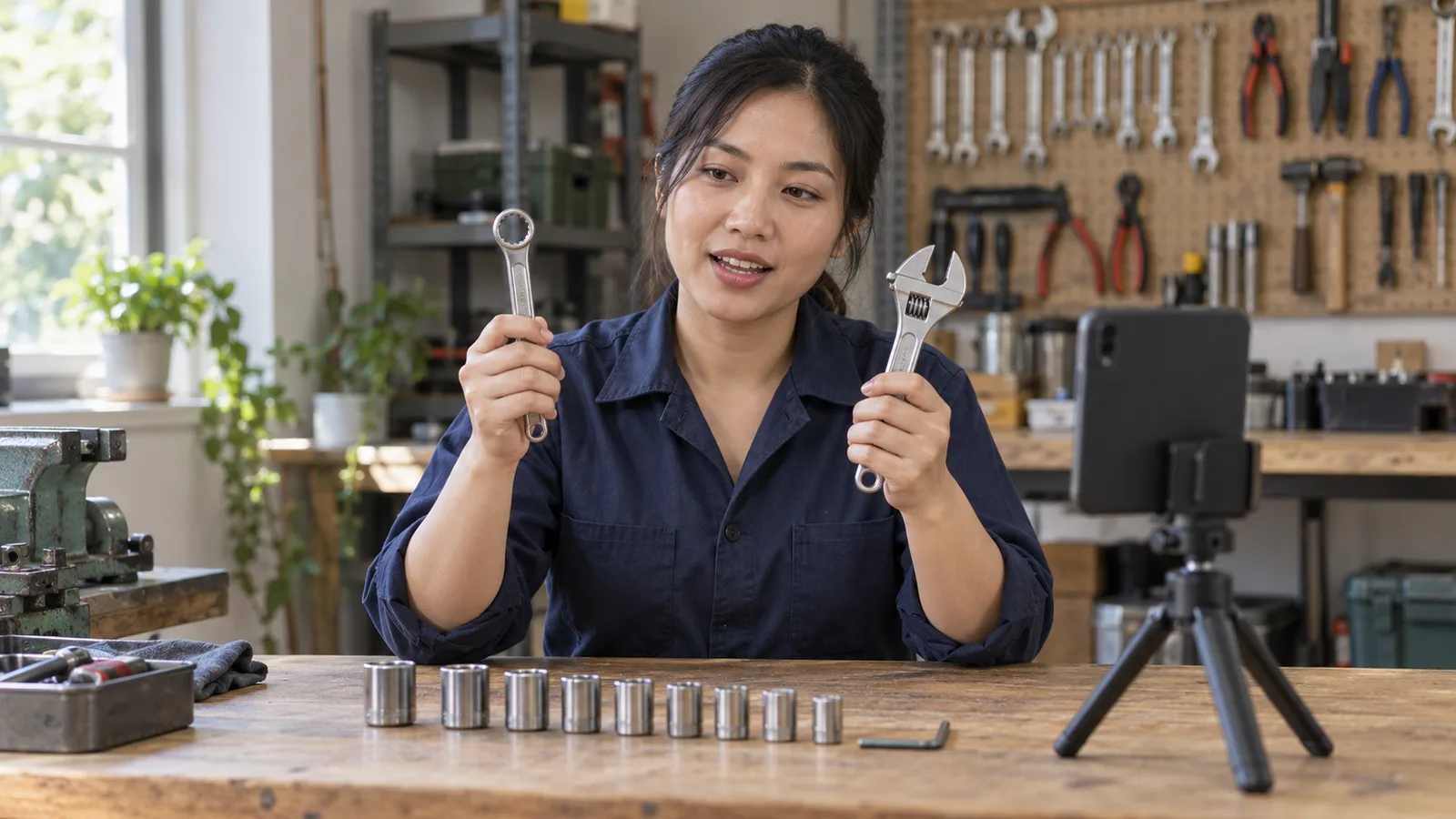
Hand tools names in English are easy to learn, but easy to say badly. In a trade interview, the interviewer may point at a tool, or ask you to explain how one works, and a wrong or unclear word makes you sound less sure than you are. Learn the names in groups by job, say each one out loud, and practise one short sentence for every tool you use.
Why interviewers ask about tools
A tool is a quick test of real experience. Someone who has used a tool for years can name it and say what it is for in a few seconds. In a skills assessment, VETASSESS says the technical interview room may be a simulated workplace containing tools and equipment, and the assessor asks questions to check knowledge and skills. One of its suggested practice questions is "Explain how a tool/piece of equipment you use works".
The same idea applies in an ordinary job interview. A workshop owner wants to know that you will understand a request like "pass me the socket set" on your first day. If you already know the common trade words in our picture quiz, that is one less worry. For the wider list of words that change between countries, see our guide to Australian trade words that confuse new arrivals.
Hand tools names in English, grouped by job
Do not learn a long alphabetical list. Your brain remembers a tool better when it sits next to the job it does. Use the groups below, and keep only the tools you really use in your own trade.
| Job | Common tools | A simple sentence to say |
|---|---|---|
| Measuring | tape measure, steel rule, set square, spirit level, callipers, feeler gauge | "I check the gap with a feeler gauge before I fit the part." |
| Cutting | hacksaw, handsaw, tin snips, side cutters, utility knife, chisel | "I cut the pipe with a hacksaw and then remove the sharp edge." |
| Fastening | hammer, screwdriver, spanner, socket set, Allen key, torque wrench | "I tighten the bolts with a torque wrench to the right setting." |
| Holding | pliers, vice, G-clamp, locking pliers | "I hold the piece in a vice so my hands stay clear." |
| Power tools | drill, angle grinder, impact driver, circular saw | "I check the guard on the grinder before I switch it on." |
Notice the pattern in the last column. Each sentence has a person (I), a tool, a job and a safe habit. That is enough for most tool questions. Our post on spanner vs wrench explains the one pair of words that changes most often between countries.
Say it so the interviewer understands
Second-language speakers usually have the same few problems. Fix these first.
- Stress on the right part. Long names such as "micrometer" and "screwdriver" have one strong part. Listen to a native speaker say the word, copy it, then record yourself and compare.
- Silent letters. The "w" in "wrench" is not spoken, so the word starts with the "r" sound.
- Similar words. "Chisel" and "chassis", "vice" and "vise", "plier" and "player" are easy to mix up. Say the whole phrase, not one word, so the meaning is clear from the sentence.
- Plurals. Pliers, snips and callipers are normally said in the plural. Say "a pair of pliers", not "a plier".
If you do not know the English name, do not freeze. Say what it does: "the tool that measures very small gaps". Then ask politely, "What do you call it here?" Workshops respect that more than a long silence. If a tool has two names in your trade, read Australian vs American English for tradespeople and pick the Australian word for Australian interviews.
How to explain a tool in four short sentences
When an assessor says "Explain how this tool works", a good answer is short and in order. Practise this method with every tool on your list.
- Name the tool and say what it is for: "A torque wrench tightens a bolt to a set amount."
- Say how you use it, in one or two steps: "I set the amount, fit the right socket, and pull until it clicks."
- Say the safety habit: "I check the tool is in good condition and I wear my PPE (personal protective equipment)."
- Give one real example from your work: "I used it on wheel nuts every day in my last workshop."
Safe Work Australia says PPE is anything a worker uses or wears to keep them healthy and safe. Mentioning safety in your answer shows the interviewer you think about it without being asked. It also matches the first area VETASSESS lists for several trades, which is workplace health and safety, including wearing correct PPE. Our guide to TRA technical interview questions and the post on what the assessor asks in a skills assessment technical interview show how these questions fit into the whole interview.
Tool words for different trades
Every trade has its own short list. VETASSESS says the interview areas for a Motor Mechanic (General) include selecting appropriate tools and equipment. For a Carpenter they include working with explosive power tools and carrying out levelling. For a Fitter they include selecting tools such as milling cutters and grinding tools.
That means you should build your list from your own job. A mechanic needs socket sizes, ratchet, breaker bar and torque wrench. A carpenter needs chisel, plane, level and nail gun. A welder needs chipping hammer, wire brush and clamps. You can see the trade pages on our trades page and practise the technical questions for yours in Skills Practice.
Practise the words out loud
Reading a list does not train your mouth. Speaking does. Pick ten tools from your own toolbox, say each name and its sentence out loud, and then answer a question without looking at your notes. On InterviewTraining.ai you watch an interviewer ask a question on video, answer out loud and get a score from 0 to 10 with what you did well, what to add and a stronger answer. The marking does not take marks off for your accent, small grammar mistakes or simple words, so you can focus on clear tool words. Read how it works to see the steps first.
If you also want to improve your general English for the days around the interview, PractiseNow offers IELTS and PTE test practice. It is a separate tool and it does not replace trade vocabulary practice.
Common mistakes with tool names
- Learning a huge list and using none of it. Ten tools you can explain beat a long list of names you cannot.
- Using only words from your home country. Check the local name for each tool and use it in the interview.
- Skipping the safety habit. Naming a grinder without mentioning the guard or eye protection sounds like half an answer.
- Saying "thing" or "that one". If you forget a word, describe the job of the tool instead.
- Pretending to know a tool you have not used. Say so honestly and explain the tool you do use for that job.
Rules and requirements can change. Check the official government website before you act.
Frequently asked questions
How many tool names should I learn before an interview?
Learn the ten to twelve tools you use most in your own trade, and be able to say what each one does in one sentence. That is more useful than a long list from the internet.
Will the interviewer test my English with tool words?
The interviewer mainly wants to know that you understand the work and can be understood. A small mistake in pronunciation is fine if your meaning is clear and you can describe the tool's job.
What if my trade uses a different name for the same tool?
Use the local name in the interview, and if you say your own word by habit, add a short description. You can say "the spanner, what we call a wrench at home", and carry on.
Should I learn power tool names as well?
Yes, if you use them. Interviewers often ask about power tools together with safety, so learn the name, the job and the guard or protection you use.
Can a picture quiz help me remember the words?
Yes. Seeing the tool while you say its name builds a stronger memory than reading a list. Our picture quiz is made for trade words, tools and safety signs.
Key takeaways
- Group tool names by job: measuring, cutting, fastening, holding and power tools.
- Learn only the tools you really use, and say each one out loud with one sentence.
- Explain a tool in four steps: what it is, how you use it, the safety habit and an example.
- If you forget a word, describe the job of the tool and ask politely for the name.
- Use the local word for each tool and include safety in your answer.
Topics
- hand tools names in english
- tools names with pictures
- workshop tools vocabulary
- power tools names
- mechanic tools names
- trade interview english